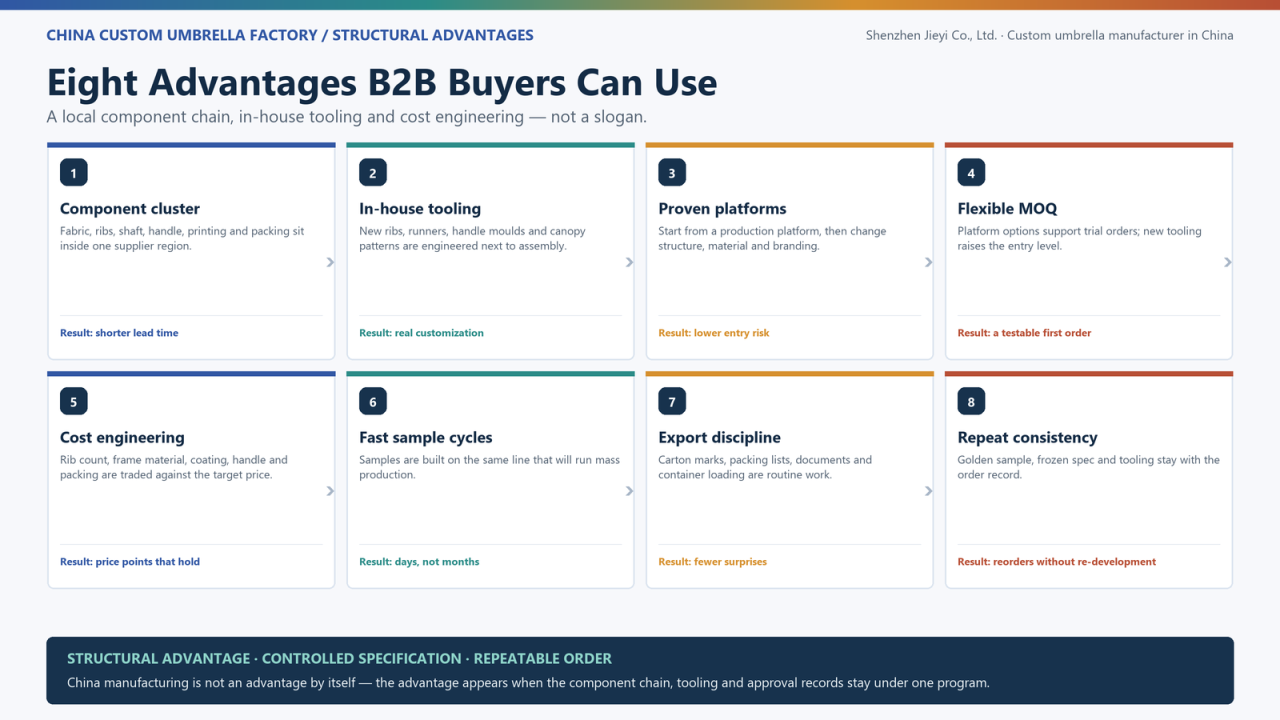
Quick answer: the advantage of a China custom umbrella factory is structural, not a slogan. Canopy fabric, ribs, shafts, handles, printing and packaging sit inside one industrial region, tooling and moulds are engineered next to assembly, and cost, MOQ and lead time are decided at specification level. A B2B buyer can therefore move from a target price to an approved sample and a repeatable order inside one program.
Advantage 1: the component chain sits in one region
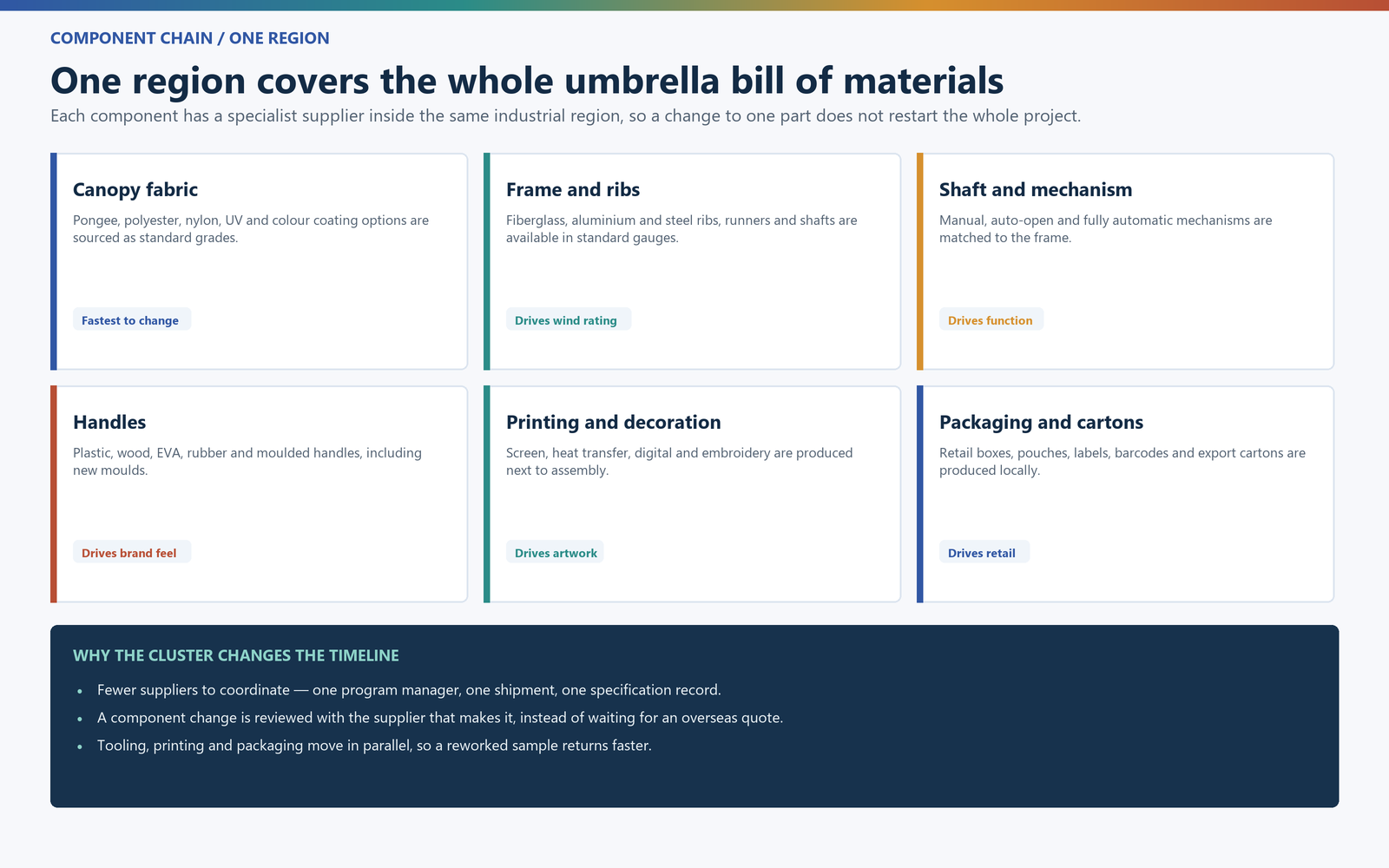
A custom umbrella is not one product, it is a bill of materials. Canopy fabric, ribs, runners, shafts, opening mechanisms, handles, printing and retail packaging are each made by a specialist supplier, and in a mature manufacturing region those suppliers sit hours apart rather than weeks apart.
That proximity shortens two clocks: sampling and rework. A canopy change, a new handle colour or a different carton mark does not restart the project, because the factory discusses it with the supplier that makes the part.
Advantage 2: tooling and moulds live inside the factory
Real customization usually needs something new: a rib profile, a runner, a handle mould, a canopy pattern or a mechanism. A factory that develops tooling in-house can tell the buyer what is genuinely new, what can be reused from an existing platform, and what the tooling cost actually buys.
Tooling is what separates modified stock from true OEM, and the customization levels guide explains where a project sits. The factory platform guide covers how much structure can be reused before new tooling is needed.
Advantage 3: customization can start from a proven platform
Most successful B2B programs do not begin with a blank sheet. They begin with a production platform that already works, then change structure, material, colour, branding and packaging. Engineering risk stays low while the product still performs like an own-brand line.
That is why buyers weighing OEM against ODM often settle on a platform-based route. They keep the differentiation they need without paying for development work they do not.
Advantage 4: MOQ is a decision, not a wall
Minimum order quantity follows the specification. A platform umbrella using existing tooling can support a trial order; a new frame, handle mould or custom retail packaging raises the entry level, because tooling and print set-up must be amortised across the run.
That lets a buyer run a small first order to test a market, then scale the same approved specification. State the target quantity in the first brief, and use the umbrella RFQ checklist so the factory can quote the honest entry level.
Advantage 5: cost engineering happens at specification level
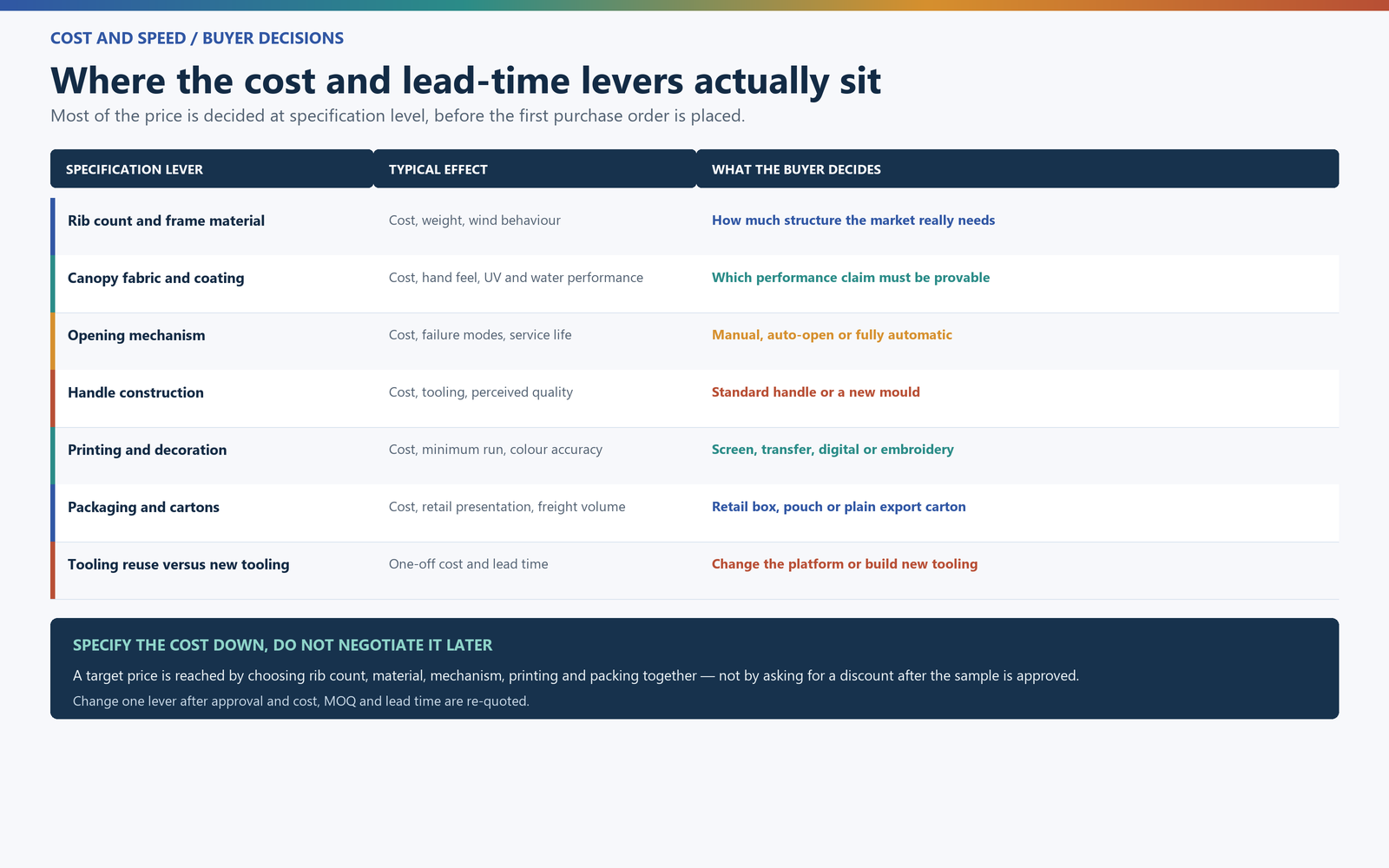
Most of an umbrella’s cost is fixed before the first purchase order: rib count, frame material, mechanism, printing method and packaging format. A factory that controls those components can trade one lever against another to reach a target price instead of quoting whatever is on the drawing.
The frame materials guide and the umbrella fabric guide show the usual trade-offs between cost, weight and performance.
Advantage 6: sample cycles are short because they use the production line
A sample is only useful when it represents production. When sampling runs on the same line, with the same materials and operators that will handle the order, the buyer learns real assembly behaviour rather than a hand-built showpiece.
Short cycles also change the commercial conversation: a buyer can compare two or three configurations before committing, and the product development process shows how concept, sample and approval connect.
Advantage 7: export packing and documents are routine
Export-ready packing is standard work for an established export factory: retail box or pouch, labels, barcodes, carton marks, packing list and loading plan. Routine execution removes surprises between the factory gate and the destination warehouse.
The import, QC, carton and shipping checklist and the custom umbrella packaging guide cover the buyer-side checks.
Advantage 8: repeat orders stay consistent
A reorder should not require re-development. When the frozen specification, golden sample, artwork and tooling records stay with the order, later production runs reuse the same approved configuration and acceptance criteria.
That continuity matters most after the first container. The OEM process milestones and the inside an umbrella factory guide show where those records are created.
How to use these advantages in a sourcing decision
Ask a prospective factory four questions. Which components does it control directly? What tooling already exists on its platforms? How does it reach a target price without changing the approved sample? How is a reorder protected? The answers separate a trading office from a manufacturer; the umbrella manufacturer selection guide lists the rest. Past that point the schedule is driven by the order itself, so it helps to know how our China custom umbrella factory B2B order process moves from channel brief to reorder.
How Shenzhen Jieyi supports B2B programs
Shenzhen Jieyi Co., Ltd. is a Shenzhen-based manufacturer of umbrellas, beach umbrellas, garden umbrellas and outdoor shade products, serving brands, importers, wholesalers, retailers, hotels and promotional buyers. The factory workflow page covers production; the Custom service page covers OEM and private-label development.
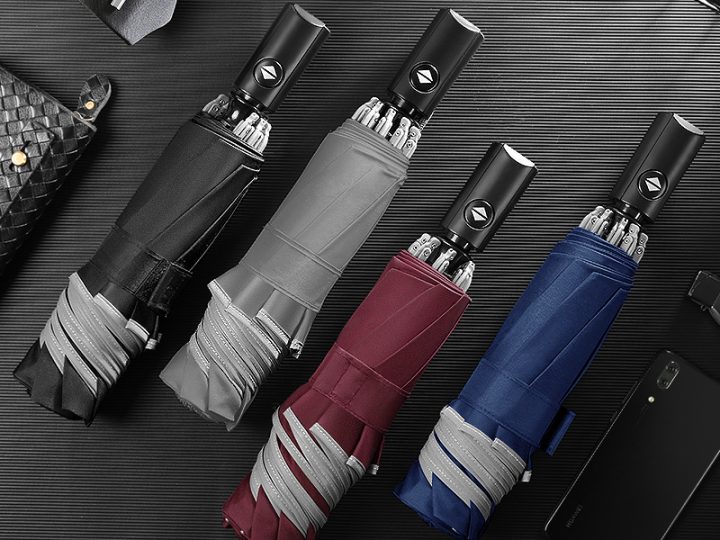
Reference models that buyers frequently adapt include the 8-rib double-layer colour-coated folding umbrella and the 16-rib automatic folding umbrella with a wood handle.
Frequently asked questions
What is the main advantage of a China custom umbrella factory?
The component chain, tooling and assembly sit close together, so specification changes, sampling and rework move faster and cost can be engineered before the order is placed.
Does a China factory automatically mean cheaper umbrellas?
No. Cost depends on rib count, frame material, fabric, mechanism, printing and packaging. The advantage is that those levers can be adjusted together.
Can a small brand order a custom umbrella?
Often yes, when the design starts from an existing platform and uses existing tooling. New tools and custom retail packaging usually require a higher order quantity.
How do I keep quality consistent on repeat orders?
Keep the frozen specification, golden sample, artwork files and inspection record together, and re-approve any change to material, fit, function or appearance.
Start a custom umbrella program
Send your market, reference product, required changes, target quantity and delivery window through the contact page. We will review the practical customization route and the order quantity that fits your first run.
Factory verification matrix: claims, questions and evidence
An advantage only matters if it can be verified. The table below turns common supplier claims into specific questions and documents a buyer can keep in the project file.
| Supplier claim | Question to ask | Evidence to keep |
|---|---|---|
| In-house tooling | Which mould, drawing or fixture is made in-house, and which parts are subcontracted? | Tooling drawing, mould photo, revision number and ownership terms. |
| Controlled components | Who produces the ribs, shaft, runner, handle and mechanism, and how are incoming parts checked? | Component specification, incoming inspection record and approved supplier list. |
| Stable bulk quality | Which measurements and functions are checked before cartons are sealed? | QC checklist, AQL level, inspection photos, measurements and sealed approval sample. |
| Reliable sampling | Which sample line is used, and what is the promised approval-to-ship window? | Sample schedule, courier record, approval comments and change history. |
| Export capability | How are label, barcode, carton mark, country of origin and document requirements handled? | Packing list, carton artwork, shipping mark, commercial invoice template and inspection release. |
Use the factory capability page as a starting point, then connect each claim to a document rather than a verbal assurance.
What actually changes the landed cost
Most quotation differences come from specification choices, not from a mysterious factory discount. Buyers should compare offers on the same written brief.
| Cost driver | Why it changes the quotation | Buyer decision |
|---|---|---|
| Tooling and new parts | A new handle mould, rib profile or runner requires development and amortisation. | Reuse a proven platform unless the new part creates a measurable product advantage. |
| Printing and colour count | Screen set-up, print positions, colour registration and drying affect unit cost. | Reduce colour count or move small logos to a woven label when appropriate. |
| Fabric and coating | Density, coating, colour fastness and UPF requirements change material and testing cost. | Match the fabric to the retail position and confirm performance requirements in writing. |
| Handle and hardware | Wood tone, finishing, laser marking, metal trim and button integration change assembly time. | Approve the handle on the complete umbrella, not as a loose component. |
| Packaging and carton cube | Sleeve, gift box, barcode, display pack and carton quantity affect freight and handling. | Model the delivered cost, not only the ex-factory unit price. |
For a structured comparison, use the umbrella RFQ checklist and the customization levels guide.
Program timeline from brief to shipment
| Stage | Typical working window | Exit evidence |
|---|---|---|
| Written brief and platform selection | Day 0-3 | Product brief, platform choice, target quantity and cost model. |
| Mockup and quotation | Day 3-7 | Artwork mockup, material options, tooling notes and quotation. |
| Sample production | Day 7-15 | Physical sample, specification sheet and colour reference. |
| Sample approval and revision | Day 15-22 | Signed approval sheet and change record. |
| Bulk materials and production | Day 22-50 | Material confirmation, production updates and inspection plan. |
| Inspection, packing and shipment | Day 50-60 | QC report, packed dimensions, carton marks and shipping documents. |
Exact timing depends on tooling, artwork, material availability and peak season. Put the timeline in the purchase order rather than relying on an email estimate.
Quality evidence for a repeatable program
- Approved sample for every colour, logo and packaging version.
- Frame, rib, shaft, runner and handle inspection records.
- Print position and colour approval under the intended light source.
- Canopy tension, folding behaviour and opening/closing test record.
- Packed unit weight, carton quantity, case dimensions and shipping marks.
- Pre-shipment inspection release and sealed production sample.
For product-specific examples, review the 16-rib long-handle umbrella and the custom umbrella category. Related technical checks are covered in the opening systems guide.