FAQ
Clear answers for brands, importers, distributors, retailers, and promotional buyers sourcing custom umbrellas from China.
Still comparing suppliers? Start with our custom umbrella manufacturing overview for capability, sampling and QC details.
Umbrella Buying Guide
3 questions
How Do You Choose the Best Umbrella for Your Brand and Market?
The best umbrella for your brand or market is not automatically the largest, lightest, or most expensive model. It is the version that fits the user, local climate, sales channel, target price, and required level of customisation. A commuter-focused retailer, a hotel sourcing guest umbrellas, and a distributor building a golf collection need different combinations of canopy size, frame strength, fabric, handle, packaging, and order quantity.
This umbrella buying guide follows the decisions a B2B buyer should confirm before requesting a quotation, from product type and canopy size to frame construction, branding, packaging, quality control, and delivery.
1. Define the user, climate, and sales channel
Start with how the umbrella will be used, not with a catalogue model. The intended user determines the acceptable weight, folded length, canopy coverage, opening mechanism, and retail presentation. Local weather then determines how much emphasis to place on wind resistance, water repellency, UV protection, and corrosion resistance.
- Urban commuters and travel retail: prioritise a short folded length, easy handling, and dependable everyday construction. Three-fold and five-fold compact umbrellas fit this channel well.
- Corporate, hotel, and premium gifting: a straight or long umbrella can create a stronger brand presence. Handle finish, metal details, presentation packaging, and logo execution matter more than extreme portability.
- Golf, resorts, and outdoor sports: specify a wide canopy, stable ribs, comfortable grip, and a structure that remains controllable in exposed conditions. Review our golf umbrella range as a starting point.
- Beach, patio, and hospitality: consider canopy diameter, pole strength, tilt or crank operation, base compatibility, and fabric fading. Explore beach umbrellas and garden formats when selecting these products.
2. Match the umbrella type and open size to the job
Open diameter is more useful than a generic size label because it shows how much protection the finished canopy provides. For folding umbrellas, also compare the folded length, because a smaller package often means more folds, more joints, and a different cost and durability profile.
As a practical starting point, travel and pocket models commonly fold to roughly 18 to 23 cm, while standard folding umbrellas balance a compact package with wider coverage. Golf and promotional umbrellas often use a 58 to 62 inch canopy, and long straight models generally provide 100 to 120 cm or more of open coverage. Beach and patio umbrellas are specified in a different size class because they are designed to shade a seating area rather than one person. Confirm the complete size, including the canopy, sleeve, and packaging, before approving retail dimensions.
3. Choose canopy fabric by performance, not GSM alone
Pongee and polyester are common umbrella fabrics because they combine a smooth hand feel, printable surface, and practical strength. Fabric density is usually described by a number such as 190T, 210T, or 220T. A higher number can indicate a denser weave, but it does not by itself guarantee better water repellency, UV performance, colourfastness, or durability. Coating, finishing, construction, and the intended use must be evaluated together.
For rain-focused programmes, confirm water-repellent finishing, seam construction, canopy tension, and how the fabric performs after repeated folding. For sun applications, request the applicable UPF rating and verify the finished canopy, colour, coating, and labelling rather than relying on a fabric claim alone. Our guide to choosing umbrella fabric explains the comparison criteria in more detail.
4. Compare frame and rib construction for wind resistance
The frame determines how the umbrella opens, locks, carries load, and responds to gusts. Fibre-reinforced polymer or fibreglass ribs can flex and return, while aluminium and steel components provide different strength, weight, and cost characteristics. The number of ribs is not the only measure of quality: rib material, thickness, joint design, shaft strength, runner alignment, and canopy attachment all affect the finished product.
A double-canopy design can improve ventilation and reduce the chance of the umbrella turning inside out in some conditions, but it cannot compensate for weak ribs or poor assembly. If wind performance is important, define a realistic test method and compare complete samples. Read our umbrella wind resistance guide and the comparison of double-canopy and single-canopy umbrellas before finalising the specification.
5. Select an opening system and handle that fit the user
Manual, automatic-open, automatic-open-and-close, fully automatic, and reverse-folding systems serve different customer expectations. More mechanism can improve convenience, but it also adds components that must be controlled during sampling and production. Choose the simplest system that meets the user’s needs and confirm the force required to open, close, and reset the umbrella.
Handles affect balance, grip, and perceived quality. EVA, ABS, rubberised, wooden, cork, and metal options offer different weight, finish, and branding opportunities. A handle that looks appropriate on a premium gift umbrella may be too heavy or costly for a high-volume promotional programme. Our umbrella handle selection guide covers material, shape, engraving, and opening-system integration.
6. Plan customisation and retail packaging together
Customisation is more than adding a logo. Buyers can specify canopy fabric, Pantone colour matching, panel layout, binding, ribs, shaft, handle, tips, runner, logo method, woven labels, hang tags, sleeves, pouches, gift boxes, and shipping cartons. Screen printing, heat transfer, digital printing, embroidery, and metal engraving each have different artwork requirements, minimum quantities, colour behaviour, and durability.
If the product will be sold at retail or used as a corporate gift, design the packaging with the umbrella rather than after it. Confirm dieline dimensions, barcode placement, country-of-origin marking, instruction labels, carton quantity, and e-commerce protection. For a wider product plan, see our guide to building a private-label umbrella collection. OEM and ODM projects can also be compared in our OEM vs ODM umbrella guide.
7. Validate the sample, QC criteria, MOQ, and lead time
Never approve a bulk order from a specification sheet alone. A physical sample should confirm the open and folded dimensions, canopy appearance, fabric behaviour, frame movement, locking points, handle balance, logo position and colour, stitch quality, packaging fit, and carton protection. Record the approved sample as the production reference and state which tolerances are acceptable.
The quality-control plan should cover incoming fabric and components, frame opening and closing, rib and joint strength, canopy tension, water repellency, UV claims where applicable, printing, assembly, final appearance, quantity, and packing. Our umbrella quality control checklist provides a useful inspection framework.
MOQ and lead time should be confirmed for the exact combination of structure, colour, logo, and packaging. Stock models may support smaller first orders, while new tooling, custom handles, special fabrics, and printed gift boxes usually require higher quantities. Production timing should include artwork approval, sample approval, material preparation, manufacturing, inspection, and packing rather than only the assembly period.
8. Send a complete umbrella inquiry
A clear inquiry helps the manufacturer recommend the right construction instead of quoting a generic product. Include the target user and market, umbrella type, open diameter, folded length if relevant, quantity, fabric and coating, frame preference, opening system, handle, colours, logo files, packaging, target price, delivery city, and required arrival date. If a specification is not fixed, explain which factors have priority: budget, weight, wind performance, UV protection, retail presentation, or delivery time.
Use our umbrella RFQ checklist to prepare the brief. The most efficient buying process is iterative: define the use case, compare a small number of suitable options, approve a physical sample, document the specification, and then scale production.
Need guidance for a specific umbrella programme? Send your requirements to our export team with the intended market and quantity. We can help compare formats, materials, branding methods, packaging, sampling, and production planning.
How Much Does a Custom Umbrella Cost?
Custom umbrella cost is not a single factory price. It is the result of product structure, order quantity, fabric and coating, opening system, handle, printing, packaging, sampling, quality control, delivery terms, and destination. A basic promotional umbrella and a premium corporate gift umbrella can look similar online but belong to completely different cost bands.
As a broad planning reference, factory-direct custom programs often fall around US$1.20–US$12 per unit before freight. Simple stock platforms at high volume can sit below that range, while premium materials, custom tooling, low order quantities, complex printing, luxury packaging, or multi-part gift sets can push the unit cost higher. Raw-material and freight markets change, so these figures should be treated as a budget guide, not a quotation.
What is included in a custom umbrella quotation?
A complete quotation should state the product specification and commercial terms. If one supplier quotes only a unit price while another includes packaging and inspection, the numbers are not comparable.
- Umbrella model, open diameter, and folded length
- Rib count and frame materials
- Shaft, runner, spring, and opening system
- Canopy fabric, density, coating, and colour
- Print method, number of colours, and print positions
- Handle type and finish
- Sleeve, pouch, box, labels, and carton
- Sample charge and whether it is refundable
- MOQ, production lead time, and inspection scope
- Incoterm, port, freight basis, and payment schedule
A lower number is meaningful only when every line above is specified in the same way. Use the umbrella RFQ checklist to prepare a comparable brief.
How order quantity changes the unit cost
Quantity affects much more than the material purchase price. Setup for fabric cutting, screen preparation, colour matching, handle assembly, packaging printing, and production scheduling is spread across the order. A small run therefore carries more setup cost per unit, while a larger run can spread those fixed costs further.
MOQ also depends on the platform. A stock umbrella frame can usually start at a lower quantity because the structure already exists. A custom frame, special handle, or new mould may require a higher minimum. Read our guide to umbrella MOQ and sampling before assuming that every model can be produced at the same quantity.
Do not assume the largest order is always best. Storage, cash flow, seasonality, and sell-through risk can make two smaller production runs more practical than one oversized order with a slightly better unit price.
How the frame and opening system affect price
Frame cost rises with material quality, component precision, corrosion protection, and mechanism complexity. A manual two-fold or three-fold frame is generally simpler than a fully automatic system. A reverse-opening mechanism adds more moving parts and requires tighter assembly control.
Fibreglass or reinforced polymer ribs may cost more than basic metal ribs, but they can improve flex, recovery, and user experience. Aluminium or premium steel shafts can reduce weight or increase strength, depending on the construction. Handle choice also matters: EVA and rubber are practical, while wood, bamboo, leather, metal, or custom-shaped grips add material and processing cost.
A buyer should compare the full frame system rather than counting ribs. Rib material, shaft diameter, joint design, runner alignment, canopy attachment, and tolerance control determine whether the umbrella feels controlled in use.
How fabric, coating, and printing affect cost
Canopy cost depends on fabric type, density, finish, colour, and performance requirements. Pongee and polyester are common starting points, but the same generic fabric name can represent different specifications. A higher thread count can cost more, although it does not automatically guarantee better water repellency or UV protection.
Coatings such as black UV, silver, or colour coating add processing steps. UPF claims may require a defined finished-canopy test rather than a simple fabric label. Review the umbrella fabric guide when comparing these options.
Printing is another major cost driver. Screen printing usually becomes economical at higher quantities but adds setup per colour and print position. Heat transfer and digital methods can suit complex artwork or smaller runs, but the unit cost and colour behaviour differ. A large canopy makes one print technically possible, but multiple panels, seam breaks, and colour matching can still affect the quotation.
How handles, accessories, and packaging affect price
Accessories appear small but change the delivered cost. A wrist strap, reflective piping, rib tips, vented canopy, custom zipper pull, branded button, or premium metal ring adds material and assembly. A wooden handle may need grain selection, staining, polishing, and protective packing.
Packaging can range from a plain sleeve to a printed retail carton, paper tube, rigid gift box, custom insert, tissue, card, and individual mailer. Retail and corporate gift programs also need accurate labels and barcodes. Review custom umbrella packaging options before fixing the target price.
Freight cost is affected by packaged volume, weight, and carton efficiency. A more protective box can reduce damage but increase shipping cost. Ask for the packed carton dimensions and quantity per carton, not only the product dimensions.
Sampling, quality control, and destination costs
Sampling cost covers material preparation, artwork setup, labour, and shipping. The sample is not just a visual check. It confirms opening force, handle balance, canopy tension, print position, colour, folded size, and packaging fit. A physical sample is usually cheaper than correcting thousands of units after a specification error.
Quality control may include incoming material checks, in-line inspection, final AQL inspection, packing verification, and container loading checks. These steps add cost, but they reduce the risk of short shipments, incorrect labels, damaged handles, print defects, or cartons that fail during transit.
The final landed cost can also include freight, insurance, customs duty, import tax, destination charges, warehousing, and last-mile distribution. Buyers comparing FOB and DDP quotations must confirm exactly which costs are included and who handles customs clearance.
Example cost scenarios
| Program type | Typical cost direction | Main reason |
|---|---|---|
| High-volume basic promotional umbrella | Lowest unit band | Stock frame, simple canopy, one-colour print, light sleeve, large run. |
| Retail folding umbrella | Low to mid band | Better frame, custom colour, retail label, printed sleeve or carton, medium MOQ. |
| Premium corporate gift umbrella | Mid to high band | Long or compact premium frame, coated fabric, special handle, detailed print, gift box, lower MOQ. |
| Custom designed or multi-part gift set | Highest band | New tooling, multiple components, premium materials, complex packaging, inspection, and low volume. |
These directions are more useful than a single online price because they explain why quotations differ. Ask each supplier to quote the exact same scenario before comparing the results.
How to compare custom umbrella quotations
Start with the specification sheet. Check that the canopy size, rib material, shaft, opening system, fabric, coating, handle, print method, packaging, carton quantity, sample terms, lead time, and Incoterm are identical. Request the quotation to show separate costs for product, printing, packaging, sample, inspection, and freight where possible.
Then compare risk. A quotation with unclear substitutions, no written specification, unrealistic lead time, or no corrective-action process may appear cheaper while carrying a higher total cost. Ask what happens if the bulk order differs from the approved sample.
How to reduce cost without reducing quality
- Use a proven stock frame for the first production run.
- Reduce unnecessary print colours and print positions.
- Standardise one or two canopy colours instead of multiple variations.
- Keep the sleeve simple when premium packaging is not part of the sales promise.
- Increase quantity only after sales or event demand is confirmed.
- Approve the full specification before sampling.
- Improve carton efficiency to reduce freight and storage cost.
What information is needed for an accurate price?
Send the umbrella type, quantity, open size, folded size, frame preference, fabric and coating, opening system, handle, logo files, Pantone colours, print positions, packaging, retail requirements, destination, target delivery date, and target price. If the specification is still open, explain the use case and let the manufacturer propose two or three cost levels.
For a practical starting point, compare the custom logo business umbrella, a 5-fold compact umbrella, or a luxury gift umbrella. Our OEM custom umbrella process shows how the brief moves from mockup and sample approval to bulk production and packing.
Conclusion: price the specification, not the word umbrella
The best way to control custom umbrella cost is to define the product and compare complete quotations. A useful umbrella at the right quality level, ordered at the right quantity, and packed for its actual sales channel usually delivers more value than the cheapest offer with an incomplete specification.
How Many Ribs Should a Custom Umbrella Have?
There is no single correct number of ribs for every custom umbrella. A six-rib design can be light and economical, eight ribs are common for compact umbrellas, ten ribs can provide a denser canopy and a more premium appearance, and 16 or more ribs are used for some fashion, promotional, and wide-canopy formats. The right count depends on canopy size, frame geometry, fabric, target weight, wind performance, opening system, budget, and how the finished product will be used.
Rib count is easier to market than to justify. Buyers should treat it as one part of the frame system, not as a standalone quality score.
What umbrella ribs actually do
Ribs support the canopy, transfer force from the fabric to the hub and shaft, and help the umbrella return to shape after opening or a gust. The upper ribs form the canopy structure, while stretcher ribs connect the runner to the main ribs and control the opening action. Their material, thickness, profile, hinge design, and attachment points all influence performance.
A higher rib count can create more support points, but it also adds components, assembly time, friction, and weight. If the ribs are thin or the joints are weak, adding two more ribs will not automatically make the umbrella more durable.
Common rib counts and their best uses
| Rib count | Typical direction | Buyer considerations |
|---|---|---|
| 6 ribs | Lightweight pocket, travel, and promotional umbrellas | Lower component count and weight; canopy coverage and wind response depend heavily on frame geometry. |
| 8 ribs | Compact, folding, commuter, and general retail umbrellas | The most common balance of canopy support, folded size, cost, and familiar appearance. |
| 10 ribs | Premium folding, business, fashion, and wider compact formats | Denser canopy appearance and more support points; check folded thickness, weight, and opening force. |
| 12-16 ribs | Wide canopies, fashion structures, and selected outdoor formats | Useful for specific canopy geometry and visual density, but not automatically stronger than a well-built 8-rib frame. |
| 16+ ribs | Special structures and design-led formats | Higher component count, tighter tolerances, more assembly risk, and a different cost and repair profile. |
How canopy size changes the requirement
A small compact canopy can work well with six or eight ribs because the panel span is short. A wide golf or promotional canopy needs more support or stronger structural geometry because the fabric spans a larger distance. When diameter increases, rib length, curvature, joint load, and canopy tension all change.
Buyers should compare open diameter and panel shape, not only the number of ribs. A 10-rib umbrella with poor tension may feel less controlled than an 8-rib umbrella with stronger ribs, accurate lengths, and a well-aligned hub.
Frame material matters more than count
Fibreglass and reinforced polymer ribs can flex and recover, while aluminium and steel ribs provide different strength, weight, and cost characteristics. The rib profile and thickness also matter. A thin metal rib can bend or corrode, while a well-designed fibreglass section may handle repeated flex more effectively.
The shaft, runner, spring, hub, and stretcher joints must work with the ribs. A strong canopy on a weak shaft still produces a poor user experience. Review the complete construction standard in our umbrella wind resistance guide.
How rib count affects wind behaviour
Wind performance depends on canopy ventilation, fabric tension, rib flexibility, joint control, shaft strength, and how the umbrella is held. More ribs can distribute force across more attachment points, but the effect depends on where the load travels and whether the frame can flex without permanent deformation.
A vented or double-canopy structure can allow air to pass through and reduce some pressure. Compare the design principles in our double canopy versus single canopy guide. Do not claim windproof performance unless the complete product has been tested to a defined standard.
Weight and folded size
Every additional rib adds material and assembly components. In a compact umbrella, the difference may be visible in weight, folded thickness, opening force, and feel. A denser 10-rib canopy may look more premium, but users who prioritise pocketability may prefer an 8-rib platform.
Ask for the complete finished weight and folded dimensions, including the sleeve. Product photos rarely communicate how the umbrella feels in a bag or how much counter and carton space it requires.
Opening system and mechanics
Manual, auto-open, and auto-open/close systems place different demands on the ribs, runner, spring, and handle. A more complex mechanism can increase opening force and create additional failure points if component tolerances are loose. The rib count must be matched to the mechanism rather than selected independently.
Test the umbrella across a production-representative sample. Open and close it repeatedly, check alignment, listen for unusual friction, inspect rib recovery, and confirm that the runner locks securely.
Cost, MOQ, and packaging effects
More ribs mean more material, more joints, more assembly operations, and sometimes a larger folded package. That can change MOQ, unit cost, carton dimensions, and freight. Fashion or low-volume programs may accept the cost for a specific appearance, while high-volume promotional programs often benefit from a simpler frame.
Ask the supplier to quote the same canopy and opening system with different rib counts when structure is the main question. Review the umbrella RFQ checklist so the comparison includes frame material, rib profile, shaft, and test requirements.
A practical rib-count test
- Open and close the sample repeatedly and check runner alignment.
- Inspect every rib for straightness, burrs, loose pivots, and uniform tension.
- Apply controlled lateral pressure and check whether the ribs flex and recover.
- Review the canopy for wrinkles, loose panels, and uneven attachment points.
- Measure finished weight and folded size with the intended sleeve.
- Ask for the applicable wind or durability test method and acceptance criteria.
- Inspect a bulk sample against the approved rib material and profile.
These checks can be incorporated into the umbrella quality control checklist before shipment.
How to specify rib count for a custom order
Start with the user and environment. A pocket umbrella may prioritise small folded size, while a business umbrella may prioritise a controlled open shape. A golf umbrella may need a larger canopy, stronger shaft, and vented construction. Then select the simplest frame that meets those requirements.
Specify the number of ribs, rib material, rib profile, length, thickness, joint type, hub construction, shaft, opening system, canopy diameter, and test standard. The number alone is not a complete specification.
Common mistakes when choosing rib count
- Assuming more ribs always means better quality.
- Changing rib count without reviewing canopy tension and folded size.
- Using a dense canopy on a weak shaft or runner.
- Comparing different frame materials as if only rib count changed.
- Making windproof claims without a defined test.
- Approving a sample without checking bulk rib material and alignment.
Conclusion: choose the frame as a system
The best rib count is the one that supports the intended canopy, opening system, user experience, and price position without unnecessary weight or complexity. For many compact and retail umbrellas, eight ribs provide a practical balance. Ten ribs can suit a denser or more premium format, while specialised products may justify a different structure.
Compare the 5-fold 6K compact umbrella for a focused compact structure or the premium windproof golf umbrella for a wider sports format. Buyers developing a new structure can review our OEM custom umbrella process and ask for a frame comparison based on one written performance brief.
New Product Customization
1 question
Can You Customize a New Umbrella on an Existing Factory Platform?
Yes, an umbrella factory can often customize a new model from an existing platform, provided the buyer separates cosmetic changes from changes that alter the frame, canopy geometry, opening system, safety condition, or performance claim. The factory should review every requested part as reuse, modify, or new tooling before it quotes the project. A production-representative sample and pilot batch are still required because a platform reduces risk; it does not remove the need for validation.
What does customization from an existing platform mean?
An existing platform is a validated umbrella architecture. It may include a defined canopy size, panel pattern, rib profile, hub, shaft, runner, spring, locking position, handle interface, and known folded dimensions. The factory may already have moulds, fixtures, suppliers, testing records, and packing data for that family.
Customization means the buyer uses that architecture as the starting point. The visible brand elements and selected commercial features can change while the proven structure remains stable. This is different from full OEM development, where the project creates a new mechanism, geometry, or product architecture.
The best platform project starts with a written change list. Without that list, a request for a “new model” can mean anything from a new colour to a completely different mechanism, and the quotation may not reflect the real scope.
Which parts can usually be customized?
Fabric, coating, colour, print, logo placement, stitching, handle colour, tips, runner finish, labels, sleeve, hangtag, and carton design are common changes. The factory may also change the handle material or shape, but this depends on the existing mould, shaft fit, fixing method, and weight balance.
A new canopy colour should be approved as a physical fabric standard because screen colours and paper references do not show how coating, texture, and lighting affect the final result. Print should be approved on the actual canopy or a production-representative mock-up because seams and curves change artwork placement.
Mechanism changes need a higher level of review. A different spring, runner, shaft diameter, rib material, or locking position can change opening force, closing feel, canopy tension, recovery, weight, and durability. Treat that work as a new configuration even when the outer canopy looks similar.
Review the umbrella customization levels to separate stock modification, platform customization, and full OEM development.
When is new umbrella tooling required?
New tooling may be needed for a new moulded handle, hub, runner, cap, or other injected component. It can also be required when the canopy panel geometry, rib length, shaft diameter, folded size, or opening mechanism changes beyond the platform's approved range.
A tooling decision should not be based on appearance alone. Ask whether the change affects form, fit, function, safety, test claims, or packing. If the answer is yes, the factory should explain what needs a new tool, what can be modified, and what must be re-tested.
Sometimes a material substitution is more practical than a tooling change. At other times, a new mould is justified by a unique market position or higher volume. Compare the commercial value of the change with the added development cost, MOQ, and lead time.
Will a platform-based umbrella still be unique?
It can be. Uniqueness comes from the combination of canopy specification, colour system, print, handle, hardware finish, branding, performance level, packaging, and retail story. A buyer does not need a new internal mechanism to create a model that looks and feels different from a stock product.
The strongest differentiation usually comes from details customers can see, touch, and understand: a distinctive colour, a branded sleeve, a comfortable handle, a lighter folded size, a better opening feel, or a packaging format that suits the sales channel.
Avoid adding changes that do not support the product position. More changes increase cost and risk without automatically creating more value. The factory platform development guide explains how to choose changes with a clear commercial purpose.
How does platform customization affect MOQ and lead time?
MOQ depends on the selected fabric, custom colour, print setup, mould or fixture requirements, handle, packaging, and supplier minimums. A platform may reduce MOQ because the main frame already exists, but it does not eliminate material or decoration minimums.
Lead time includes the brief, feasibility review, artwork approval, sample production, sample evaluation, revisions, material preparation, pilot production, bulk manufacturing, inspection, and packing. Peak season, component availability, and test requirements can change the schedule.
For an accurate plan, send the quantity, target price, target market, use case, required performance, artwork, packaging format, and required delivery date together. Use the umbrella RFQ checklist so the factory can state assumptions and exclusions clearly.
What should be validated in the sample?
Open and close the sample repeatedly, check canopy tension and recovery, inspect print registration, compare the colour under agreed lighting, test the handle and runner, measure folded dimensions, check weight and balance, review the sleeve and carton, and confirm that all labels match the specification.
If the product claims wind resistance, water repellency, UV protection, or recycled content, confirm the exact production material and test method. A claim from the base platform may not cover a changed canopy, coating, or mechanism.
The approved sample should remain at the factory as the physical standard. Any change after approval should have a new revision number and written confirmation before production continues. The quality control checklist can be adapted to the platform configuration.
What information should the buyer send to the factory?
Provide the product use, target country, sales channel, price band, order quantity, canopy size, folded length, target weight, opening type, performance requirements, colour references, artwork files, handle preference, packaging plan, and required delivery date.
Also state what must remain fixed and what can be changed. If the brand wants to preserve a particular platform feature, say so. If the model must fit a display, gift set, or existing carton, send those dimensions and restrictions.
A short technical brief is more useful than a long collection of inspiration images. The factory needs measurable requirements and priorities. Finish with a feasibility review that lists reuse, modification, tooling, testing, MOQ, cost, and schedule assumptions.
Is platform-based customization right for your brand?
It is a strong option when speed, controlled investment, and a reliable quality baseline matter more than a completely new mechanical design. It also works well when the brand needs related models for different markets, price points, or sales channels.
Full custom development is better when the product needs a new opening system, a proprietary safety feature, a unique canopy shape, a new folded size, or a mechanism that cannot be adapted from an existing platform. The decision should follow the product goal rather than the buyer's preferred label.
Start with a clear brief, choose the closest validated platform, classify every change, and approve a production-representative sample. This gives the project the best balance of market differentiation, manufacturability, and commercial control.
To discuss a new umbrella model, use the platform-based umbrella customization service or contact the umbrella factory with your requirements.
B2B Product Planning
2 questions
How Many Rain Umbrella SKUs Should a B2B Buyer Launch First?
Answer: most B2B buyers should launch with three to five rain umbrella SKUs. A practical starting range is one compact entry model, one core 23-inch folding umbrella, one premium long-handle model, and one or two controlled variants for travel, a specific market, or a seasonal colour. The exact number depends on the sales channels, price bands, MOQ, and how much inventory the buyer can manage.
What does an SKU mean in a rain umbrella range?
An SKU is a sellable configuration, not just a model name. The same umbrella becomes a different SKU when the canopy size, fabric, colour, opening system, handle, logo position, sleeve, packaging, or barcode changes in a way that the buyer must forecast and stock separately.
This is why a small product range can still create a large inventory problem. Three base models with four colours each may represent twelve SKUs before packaging or market variations are added.
The buyer should count configurations from the customer’s and warehouse’s point of view, not from the factory’s product-family view. That count drives fabric minimums, print setup, order planning, and reorder complexity.
Why should a first B2B range stay focused?
A focused launch makes it easier to forecast demand, approve samples, train sales teams, and maintain stock. It also reduces the risk of slow-moving colours and packaging versions that were created for an imagined customer rather than a confirmed channel.
Fewer SKUs do not mean less differentiation. They mean the differentiation is concentrated in the features that matter: one model for travel, one for everyday business use, and one for premium or gift positioning.
Review the customization levels before adding new tooling or components. A new colour or sleeve is usually a lighter commitment than a new frame or mechanism.
What should the first three SKUs cover?
The first SKU can be a compact folding umbrella for travel, promotional, or opening price points. It should be easy to carry, reasonably lightweight, and simple to merchandise.
The second SKU can be the core model: a 23-inch folding umbrella with a stronger frame, a practical canopy, and full branding options. This is often the highest-volume product for distributors, corporate gifts, hotels, and business retail.
The third SKU can be a premium long-handle umbrella for gift, hotel, heritage retail, or executive programs. It should show a clear upgrade in handle, finish, canopy, or presentation rather than only a higher price.
Compare formats in the compact umbrella range and the broader rain umbrella category.
Should the compact or long-handle model come first?
Start with the format that fits the strongest confirmed channel. A travel retailer, promotional distributor, or marketplace seller may need the compact model first. A hotel group, premium retailer, or corporate gift buyer may need the long-handle model first.
Do not launch both formats at full width simply because the factory can produce them. Make one format commercially proven before adding the next tier.
The core 23-inch folding umbrella often sits between those two needs and can serve as the volume anchor for the range.
How many colours should each first SKU have?
Two or three core colours per model are usually enough for the first launch. Choose colours that support the brand, fit the market, and can share fabric or coating where possible. Add a seasonal or accent colour only when a customer or channel has confirmed demand.
Colour approval should use a physical standard on the actual canopy material. Lighting, coating, texture, and print can change the final result.
Keep the assortment logic simple: one neutral, one brand-led colour, and one optional seasonal or market-specific option.
How should market and packaging variants be counted?
A different language insert, retail box, barcode, or market-specific label may create another SKU even if the umbrella is the same. Count those variations before placing the fabric and packaging order.
Where possible, share the umbrella platform, sleeve, carton, and documentation and localise only the part that must change. This keeps the product range coherent and reduces minimum-order pressure.
Use the canopy size guide to confirm whether each market needs a different coverage or folded-size specification.
What should be validated before the first order?
Approve one production-representative sample for each base model. Check open and folded size, weight, opening and closing, canopy tension, print position, handle fit, sleeve, label, barcode, and carton.
Confirm the exact rain-related performance claims, test methods, and production materials. A sample made with a different fabric or coating does not validate the bulk product.
Then run a pilot or first-production inspection before scaling the range. The MOQ and sampling guide explains how to plan this stage.
How do you add more SKUs later?
Add new SKUs only after the first range provides evidence: sell-through, repeat orders, customer requests, channel feedback, or a confirmed tender. Use the same technical platform where possible and keep the new variant clearly different from the existing range.
A later SKU may be a different canopy size, a lighter travel model, a more premium handle, a market-specific print, or a gift package. Each addition should have a defined customer and price position.
For the factory-side development path, see the B2B custom rain umbrella program guide. For range planning, read the three-tier rain umbrella range guide.
What is the best first-launch SKU count?
For most B2B buyers, three base SKUs are the best starting point. A fourth or fifth SKU should be justified by a specific market, customer, channel, or seasonal opportunity.
Start with a compact entry model, a core folding model, and a premium long-handle model. Keep colours, packaging, and market variants controlled until demand is proven.
This approach gives the buyer enough range to sell without creating unnecessary tooling, MOQ, sampling, warehousing, and reorder complexity.
How Should B2B Agents Distribute a New Custom Umbrella Range?
Short answer: allocate a new umbrella range by evidence, not by dividing stock equally. Give 60% to the core market or channel with proven demand, 25% to one controlled expansion market, and 15% to samples, key accounts, and early replenishment. One master specification should serve all regions, with localisation limited to approved colour, logo, packaging, label, and carton changes. Review sell-through, returns, stock cover, and reorder velocity before adding another distributor, SKU, or territory.
Start with channel roles, not territory count
A distributor’s location is less important than its route to the customer. Map each partner as a retail distributor, promotional reseller, key-account supplier, online seller, hospitality supplier, or regional sub-distributor. Then decide which product position that channel can actually sell.
A supermarket distributor may need a clear opening price and efficient cartons. A hotel or gift distributor may need premium packaging and a smaller order. An online seller may need strong photography and a colour range that supports repeat browsing. These differences should influence allocation before the first production order is placed.
Use a 60/25/15 launch allocation
The core market should receive enough stock to test repeat demand properly. The expansion market should be large enough to reveal whether localisation works but small enough to limit exposure. The reserve protects samples, urgent key-account requests, and early replenishment while production lead time is still active.
This allocation is a starting rule, not a permanent split. Once sell-through data is available, reallocate by actual reorder velocity and stock cover. Do not continue funding a market simply because it received equal treatment in the original plan.
Match product roles to the sales channel
Use three launch positions: entry, core, and premium. The entry model supports price-led enquiries and promotional volume. The core model carries the main stock programme and should be easiest to localise. The premium model supports key accounts, gifting, and margin.
Keep the product ladder visible. If two models have nearly the same specification, consolidate them. If the premium model differs only by colour, the sales team may struggle to justify the price gap. A stronger frame, better canopy, upgraded handle, improved opening system, or gift-ready pack creates a clearer reason to trade up.
The B2B distribution range guide shows how a range can be planned around distinct customer needs instead of a long list of unrelated samples.
Localize without creating a new product for every market
Start with one approved umbrella platform. Define which fields may change by market: canopy colour, logo method, handle finish, sleeve, label language, retail carton, and barcode. Keep dimensions, materials, frame, mechanism, and performance claims inside the approved specification.
This approach protects MOQ, simplifies quality control, and lets distributors reorder with one platform code. It also prevents the common problem where several distributors ask for small changes and unintentionally create several separate products.
Use the OEM umbrella distribution programme to define localisation zones, approved variants, and documentation before sampling ends.
Control price, inventory, and exclusivity
Set a pricing framework that includes landed cost, packaging, freight, duty, distributor margin, retail margin, returns provision, and local marketing. The distributor should understand the price floor at which the channel can no longer support the required service.
Exclusivity should be earned. Tie it to territory, customer type, minimum purchase, launch date, or stock commitment. When a partner cannot meet the terms, use a controlled colourway, model name, or pack to protect differentiation without blocking the wider market.
Assign inventory ownership clearly. State who pays for samples, tooling, artwork, market-specific packaging, excess stock, and obsolete components. The same applies to warehousing, insurance, and local delivery.
Give every distributor the same launch kit
Prepare a production-representative sample, specification sheet, colour references, packaging example, product photography, approved claims, carton data, and reorder code. Include the exact localisation options and the approval process for changes.
A consistent kit lets agents sell with confidence and reduces conflicting messages across markets. It also helps the factory identify whether a requested change is a new project or a controlled variant. Use the RFQ checklist when collecting missing technical or commercial details.
Review the first 60 days by channel
Measure units sold by channel and SKU, stock cover, reorder requests, quotation conversion, returns, defect complaints, average selling price, and the reason customers chose one model over another. Separate weak demand from weak distribution. A good product placed in the wrong channel can look like a product failure.
Interview the sales teams, not only the owners. They can explain which price point creates resistance, which package is difficult to display, which colour sells consistently, and which model generates after-sales questions. Record these findings against the SKU and market.
Scale only when two signals agree
Add a new territory, colour, or pack when at least two signals support the decision: strong sell-through, healthy reorder velocity, stable quality, acceptable returns, or positive margin after distribution costs. If only one signal is positive, run a smaller test before committing inventory.
Use the quality control checklist during replenishment so growth does not weaken consistency. Every production lot should still match the approved sample, packaging, carton, and label data.
Build the next allocation from actual demand
Replace the opening 60/25/15 split with a data-based plan. Move stock toward channels that sell without excessive discounting, reorder on time, and produce acceptable returns. Reduce or redesign the position that consumes working capital without creating repeat demand.
For the full rollout method, read the new umbrella distribution plan for B2B agents. Review the custom umbrella product range to match platform choices with each channel role.
Wholesale Agent Programs
10 questions
What Does a B2B Umbrella Wholesale Agent Need Before Private Label Production?
Answer: before private-label production, a B2B umbrella wholesale agent should lock the product brief, target market and price, artwork and packaging, production-representative sample, MOQ and lead time, brand ownership terms, quality standard, shipping requirements and reorder specification. The factory should confirm the exact frame, canopy, opening system, handle, accessories, print method and performance test before bulk production begins.
The agent does not need a large catalogue for the first order. It needs enough commercial and technical detail to make one product repeatable, sellable and easy to explain to the next customer.
What is the commercial role of the new umbrella product?
Start by defining who will buy the umbrella, where it will be sold and what it should achieve. A hotel programme, promotional distributor, gift company, retail chain and online seller may use similar product formats for very different reasons.
Record the target country, customer type, sales channel, price band, estimated quantity and launch date. This information helps the factory select a realistic platform instead of proposing features that do not fit the market.
The agent should also decide whether the product is a hero model, a volume model or a premium/channel model. The commercial role determines how much differentiation is needed and how much the programme can spend on tooling or packaging.
What product brief should the agent provide?
Provide open diameter, folded length, target weight, canopy fabric and coating, rib count, frame material, shaft, opening system, handle, logo position, print method, sleeve, label, carton and barcode requirements.
Include the intended performance claims and the market where those claims will be used. A water-repellency, UV or wind-resistance statement should be linked to a test method and the actual production materials.
Use the umbrella RFQ checklist to organise the information. A complete brief makes quotations comparable and reduces the chance that a sample is approved against different assumptions.
Which brand and packaging assets must be approved?
The agent should provide final logo files, artwork dimensions, colour references, font requirements and packaging copy. If a third-party designer is involved, confirm who has permission to approve proofs and who owns the final files.
Approve colour on the intended canopy material, not only on a screen or paper swatch. Check logo placement on an opened and closed umbrella because seams, folds and tension can change how artwork appears.
Packaging should include sleeve, hangtag, label, retail carton, barcode and any market-specific insert. Consider whether the agent needs its own brand, a customer brand or unbranded packaging for flexibility.
What sample evidence should the factory provide?
The agent needs a production-representative sample using the intended frame, canopy, opening system, handle, print method, hardware and packaging. A digital mockup or display sample can support the discussion but should not replace the final physical standard.
Check open and folded dimensions, weight, balance, opening and closing, canopy tension, stitching, print registration, handle security, sleeve fit and carton quantity. Photograph the approved sample and record measurements.
The quality control checklist can be adapted to the agent programme before the pilot or bulk order.
What MOQ and pricing terms should be agreed?
Confirm minimum order quantity by model, colour, print method and packaging version. MOQ is affected by frame, fabric, custom colour, print setup, handle tooling and carton format, so a single number without assumptions is not enough.
Request a price breakdown for the umbrella, logo, packaging, sampling, tooling, inspection and freight. Confirm price validity, payment schedule, production capacity, delivery window and the conditions that can change the price.
Repeat-order terms should state reorder MOQ, lead time, material continuity, colour tolerance and the process for adding a new SKU. The MOQ and sampling guide explains how to align the sample round with the first production quantity.
How should territory and exclusivity be defined?
If the agent expects exclusivity, define the product, country or territory, channel, duration and minimum performance condition. A vague promise that a model will be exclusive to one agent is difficult to monitor and enforce.
For non-exclusive programmes, define whether competitors may buy the same platform and whether the agent has a protected colour, packaging design, model name or customer segment.
The agreement should also clarify how direct factory enquiries are handled and how the agent’s customer list and sales data are protected.
Which quality and shipping documents should be requested?
Ask for the approved specification, Bill of Materials where appropriate, inspection standard, sample approval record, packing list, carton dimensions, gross and net weight, shipping marks and any relevant test report.
Confirm how defects are classified, how replacement stock is handled and who pays for rework or return freight. For regulated markets, confirm the documentation needed by the importer or retailer before production starts.
Do not assume that a general factory certificate replaces product-specific testing. The required evidence should match the umbrella, the market and the claim being made.
What should happen before the first bulk order?
Complete a written brief, feasibility review, quotation, mockup, sample approval and locked specification. Run a pilot or first-production inspection when the product or process is new.
After the first order, review sell-through, returns, quality feedback and repeat demand. Use that evidence to decide whether to add a colour, a premium handle, a different canopy size or a market-specific package.
For the full launch process, read the wholesale agent private-label launch guide. For factory development, see the OEM umbrella programme for wholesale agents and the broader custom umbrella range.
Is the 5-Fold Black UV Capsule Umbrella Good for B2B Trade?
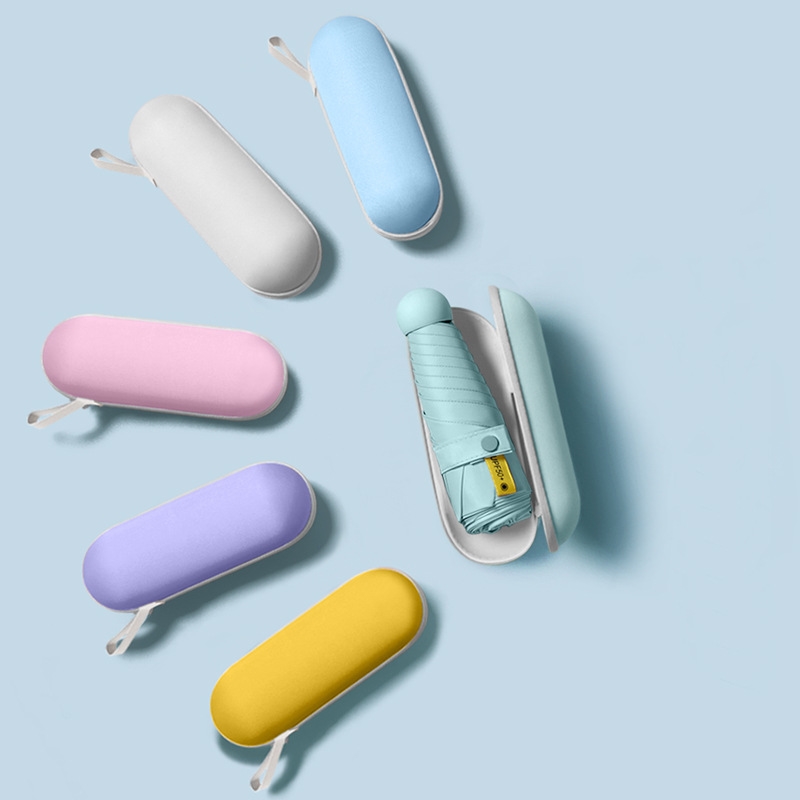
Short answer: yes. The 6-rib 5-fold black UV capsule umbrella is a practical B2B trade product when the distributor targets fashion retail, e-commerce, beauty promotions, travel shops, gift programmes, or private-label sun protection. Its compact capsule format is easy to display and ship, while the black UV-coated canopy is listed at UPF 50+. The product works best as a high-turn, colour-led SKU that is customised through logo printing, capsule colour, labels, sleeves, and retail packaging rather than a new frame development.
What product is being introduced?
The product is model 011, a 6-rib five-fold capsule umbrella. It uses pongee fabric with a black UV coating listed at UPF 50+, six fibreglass ribs, and a steel centre shaft. The handle is plastic and the opening system is manual open and close.
The closed packing size is 22 x 7 x 7 cm, the carton quantity is 60 pieces, and the unit weight is approximately 0.35 kg. Standard colours are Mint Blue, Matcha, Yellow, Black, Wine Red, and Dark Green. The official product page is available here: 6-rib 5-fold black UV capsule umbrella.
Which B2B channels can distribute it?
The small capsule case gives the product a clear retail and gift story. It can suit beauty gift-with-purchase campaigns, fashion e-commerce, boutique retail, travel accessories, summer promotions, employee gifts, membership rewards, convenience-store programmes, and private-label sun-protection collections.
An agent should match the product to the channel rather than selling the same colour mix everywhere. A cosmetics retailer may want pastel capsule colours and a branded gift sleeve. A travel shop may prefer compact neutral colours and efficient cartons. An online seller may need six colour images and a simple reorder code.
Compare the model with the compact umbrella range and sun umbrella category when deciding how it fits a distributor catalogue.
How should agents customise this product?
The product supports logo printing, custom canopy colours, capsule branding, woven labels, hang tags, branded sleeves, and retail packaging. Keep the frame, rib count, shaft, opening system, and closed size fixed. Localise the canopy colour, capsule colour, logo, label, sleeve, or carton only where that change improves the channel.
A distributor should not create a separate structural product for every campaign. Use one approved platform and a small controlled variant matrix. A beauty gift may need a pastel capsule and gift sleeve, while a corporate buyer may need black or wine red with a small logo and neutral retail carton.
Use the umbrella customization levels to separate approved branding changes from new product development.
Is it suitable for a first wholesale and agency order?
It can be suitable when the distributor has a defined channel with a clear summer, travel, or gifting use case. The product is compact, lightweight, and visually easy to display, which reduces retail friction. It also has enough colour options to create a focused range without requiring new tooling.
The first order should prove demand with two or three colours and one packaging direction. Do not open every colour before sell-through is known. Track units sold by colour, reorder requests, stock cover, returns, and the percentage of sales supported by gift or promotion activity.
Review the MOQ and sampling guide before confirming the first production quantity.
How should the product be priced in a trade catalogue?
This model normally sits in the compact or entry-to-mid price position. The capsule case and UV coating support a higher perceived value than a basic pouch umbrella, but the final price depends on canopy colour, capsule colour, logo method, sleeve, packaging, carton, freight, duty, and channel margin.
Build a price ladder for the distributor rather than quoting one unit price. Show the product with standard packing, a branded sleeve, and a retail gift pack if those configurations are available. Confirm the per-colour and per-print minimum before promising a low price for a multi-colour programme.
What should be confirmed before bulk production?
Approve the canopy colour, capsule colour, logo position, print size, sleeve, label, barcode, retail carton, and carton quantity. Confirm whether the 60-piece carton remains unchanged when packaging is localised. Agree the opening and closing action, canopy tension, rib recovery, stitching, capsule fit, handle condition, and print registration.
Keep a sealed sample with the order. Check production against the approved canopy, capsule, logo method, packing, and carton. The umbrella RFQ checklist helps collect the information needed for a comparable quotation.
What quality checks matter for a capsule umbrella?
Check the five-fold folding action, rib alignment, shaft security, canopy tension, stitching, UV-coated fabric appearance, logo durability, capsule closure, zipper or opening detail, sleeve fit, colour consistency, carton count, and barcode.
Because the product is compact, small differences in folding and capsule fit are very visible in retail. Inspect the actual production run rather than only the first sample. Use the umbrella quality control checklist for the warehouse or third-party inspection plan.
How should distributors sell it to sub-distributors?
Provide a product sheet with closed size, weight, carton quantity, UV protection statement, colour references, logo placement, capsule image, packaging options, and reorder code. Include channel-specific photography for beauty, travel, and fashion use.
Do not make unsupported UV, waterproof, or performance claims beyond the approved product specification. Clearly state that the opening system is manual open and close. The distributor sales pack should help sub-distributors present the product consistently and avoid ordering the wrong colour or pack.
What is a practical launch plan?
- Choose one primary channel and two secondary channels.
- Select two or three colours based on the target customer.
- Approve the canopy, capsule, logo, sleeve, and carton sample.
- Order a pilot quantity and provide product photography to resellers.
- Review sell-through and reorder requests before expanding the colour range.
The product can also be developed as an OEM programme with a controlled capsule and canopy platform. Review the OEM Custom programme and the companion 27-inch golf umbrella trade guide for a different long-umbrella channel strategy.
Final trade recommendation
The 5-fold black UV capsule umbrella is a sensible B2B trade product when a distributor needs a compact, giftable, colour-led SKU for fashion, travel, beauty, e-commerce, or promotional channels. Start with a controlled platform, a focused colour mix, a production sample, and measurable sell-through. Add colours or packaging variants only after the first channel proves repeat demand.
For a wooden-handle long umbrella in the same trade mix, review the OEM 63.5cm wooden-handle golf umbrella trade programme.
Send the intended market, channel, quantity, logo, capsule colour, packaging, and delivery country through the contact page to request a product-specific quotation.
Is the Automatic Long Umbrella with Waterproof Cover Good for B2B Wholesale?
Quick answer: yes, an automatic long umbrella with a waterproof cover can work well for B2B wholesale when the buyer needs a full-size business umbrella for hotels, banks, automotive programmes, retail, corporate gifts, promotional distribution, or travel channels. The product should be sold as a defined platform with approved fabric, automatic opening action, handle, cover, logo, and packaging. Confirm the exact rib count and colour-specific configuration before production, because product listings can reference more than one JY series variant.
This guide introduces one product, model 003 / JY series, and explains how an agent, distributor, or private-label buyer can evaluate it for wholesale trade.
Product snapshot: automatic long umbrella with waterproof cover
The product is a long business umbrella supplied with a protective waterproof cover. The listed platform uses pongee fabric, fibreglass ribs with a steel centre shaft, automatic opening with manual closing, and a rubber handle. The product reference shows 63.5 x 24, 40 pieces per carton, and approximately 0.6 kg unit weight. Standard colour references include Deep Grey, Rubber Pink, and Starry Black.
Some colour names in the JY series may indicate a different rib configuration or model naming convention than the general product attribute table. Buyers should treat the rib count as a specification item to confirm rather than assuming that every colour uses the same construction. The approved quotation and sealed sample should state the final canopy, rib count, shaft, opening action, cover, and packing.
Review the automatic long umbrella with waterproof cover page for the current product data before building a quotation.
Which B2B channels fit a long umbrella with a cover?
A long umbrella offers more coverage than a compact folding model and is easier to show in a lobby, vehicle, hotel, bank, or premium retail setting. The cover adds a practical handling feature because a wet umbrella can be placed inside a protective sleeve during transport or storage. The exact water-resistance claim should still follow the approved fabric and coating specification.
Potential channels include:
- Hotels, resorts, clubs, and hospitality groups that want branded guest umbrellas.
- Banks, insurance companies, and professional-services firms buying executive gifts.
- Automotive dealerships, mobility services, and roadside programmes.
- Department stores, business-accessory retailers, and travel shops.
- Promotional distributors building premium corporate campaigns.
- Wholesale agents seeking a long-umbrella tier alongside folding models.
The long format is not always the lowest-cost option, so the sales story should emphasise coverage, presentation, the automatic opening action, and the protective cover rather than only the unit price.
What can be customised for wholesale and private label?
Buyers can request logo printing, custom canopy colours, handle details, a branded waterproof cover, woven labels, hang tags, instruction cards, barcodes, and retail packaging. The best programme separates product-critical choices from branding choices.
Keep the canopy construction, shaft, opening system, handle platform, and cover fit stable unless the buyer is prepared for a new development and validation process. Localise the logo, colour, sleeve, label, language, barcode, and carton for each market. That creates a controlled range for distributors without turning every order into a new product.
Use the umbrella customization levels guide to decide whether a request is a light private-label change, a platform modification, or a new umbrella project. A different rib count or frame architecture is not a simple logo change.
What should be confirmed before requesting a quotation?
The brief should include the target country, sales channel, estimated annual quantity, launch quantity, preferred colour, canopy material, rib count, radius or canopy size, opening and closing system, handle type, cover style, logo artwork, packaging format, barcode requirement, and delivery timeline.
The buyer should also confirm whether the product needs a specific UV, water-resistance, wind, or durability claim. Do not repeat a marketing statement unless the factory can support it with the approved material and test specification. If a colour variant is named differently in the catalogue, request a written bill of materials and a photo or sample that identifies the exact construction.
The umbrella RFQ checklist helps keep competing quotations comparable. It also reduces the risk of comparing a basic umbrella quote with one that includes a branded cover and retail packaging.
MOQ, sampling, and the first wholesale order
Start with one or two colours and a focused packaging direction. Approve a production-representative sample that includes the canopy, ribs, shaft, automatic opening action, manual closing action, handle, cover, logo, label, and carton. Confirm how the cover fits when the umbrella is wet and whether the selected fabric and coating meet the intended storage use.
The first order should test a real channel rather than every possible market. If the product is intended for hotel groups, use a restrained brand treatment and a clear guest-facing cover. If it is intended for automotive promotions, test a higher-contrast pack that works in a vehicle or service context. The MOQ and sampling guide can help structure the pilot order.
Record the approved colour, rib count, opening action, cover, logo, packaging, and carton quantity in a master specification. Reorder from that specification, not from an old photograph or an unversioned spreadsheet.
What quality checks matter for a long umbrella programme?
Inspect the automatic opening action, manual closing action, rib alignment, shaft security, canopy tension, stitching, fabric appearance, handle attachment, cover fit, and logo durability. Check whether the umbrella can be closed, secured, and inserted into the cover without excessive force. Inspect the cover seams, opening, closure, and branding position.
For retail and corporate orders, verify the label text, barcode, instruction card, retail box, carton count, shipping mark, and colour consistency. A long umbrella is highly visible when opened, so canopy defects and uneven ribs are difficult to hide in a customer presentation.
Use the umbrella quality control checklist to prepare an inspection plan. Keep the approved sample with the order and check the production run against the same reference.
How distributors and agents can position the product
Position the product as a full-coverage business umbrella with a protective cover, not as a generic promotional item. Build channel-specific photography: a lobby or hotel scene for hospitality, a vehicle or service desk for automotive, a clean studio image for corporate gifts, and an outdoor rain scene for retail.
Give sub-distributors a specification sheet, colour card, logo placement guide, cover image, packaging options, carton quantity, and reorder code. Explain the difference between automatic opening and manual closing so the sales team does not make an unsupported claim. If the product is offered as a private-label programme, link the buyer to the OEM 10-rib business black UV folding umbrella trade programme for a controlled OEM example.
For a compact channel strategy, the reversible camo umbrella wholesale trade guide shows how one platform can serve multiple reseller groups. The same principle applies here: keep the long-umbrella platform stable and localise the branding layer.
What pricing and repeat-order strategy should distributors use?
Build the price from the umbrella, canopy colour, logo, cover, labels, retail packaging, carton, freight, duty, inspection, and distributor margin. Present at least two configurations: a standard trade pack and a branded retail or corporate pack. This helps the distributor explain why the landed price changes without hiding the base product cost.
Review sell-through by colour, account, channel, and cover version. If one configuration creates repeat requests, expand that version before adding a new mechanism. Track returns, cover damage, logo defects, and reorder lead time as well as unit sales.
Is the automatic opening action suitable for premium B2B gifts?
It can be when the full specification, handle, cover, logo, and packaging support the gift position. The automatic opening action is easy to demonstrate, while the long canopy gives the product more presence than a compact folding umbrella. Confirm the opening and closing sequence in the sample and train the sales team to describe it accurately.
What is the biggest specification risk?
The biggest risk is assuming that every colour or JY series reference uses the same rib count or construction. Confirm the bill of materials, rib count, radius, shaft, opening system, handle, cover, and packing for the exact SKU before quoting. If the catalogue wording is ambiguous, use the approved sample and written specification as the commercial reference.
Final B2B recommendation
The automatic long umbrella with waterproof cover is a credible wholesale product for buyers who need full coverage, a business-friendly format, automatic opening, and a practical protective cover. Build the programme around one approved platform, a focused colour range, a controlled branding layer, and a documented quality standard. The result is easier to quote, inspect, distribute, and reorder.
Send the target channel, quantity, colour, rib-count requirement, logo file, cover specification, packaging brief, and delivery country through the contact page to request a product-specific quotation.
Is the 6-Rib 5-Fold Black UV Mini Thumb Umbrella Good for B2B Wholesale?
Quick answer: the 6-rib 5-fold black UV mini thumb umbrella is a practical new B2B product for distributors that need a very small, lightweight umbrella with a strong gifting, travel, beauty, e-commerce, or promotional story. Model 99896 uses a 210T pongee canopy with black UV coating and a listed UPF 50+ rating, six fibreglass ribs, a steel centre shaft, a rubber handle, and manual open and close. It weighs approximately 0.25 kg and packs 60 pieces per carton.
This article profiles one product and explains how a wholesale agent, distributor, or private-label buyer can evaluate it for a focused B2B programme.
Product snapshot: model 99896
Model 99896 is a 6-rib five-fold mini thumb umbrella with a 210T pongee canopy. The black UV coating and UPF 50+ protection are listed in the supplied product data. The frame has six fibreglass ribs and a steel centre shaft, while the rubber handle supports a compact manual grip.
The listed radius is 42-52 cm, carton quantity is 60 pieces, unit weight is approximately 0.25 kg, and standard packing is a fabric sleeve with OPP bag. Standard colours are Black, Sky Blue, Green, Pink, and White. Confirm the final packed dimensions, handle colour, canopy colour, sleeve, and carton reference in the approved sample.
Review the wholesale 6-rib 5-fold black UV mini thumb umbrella for the current product specification.
Why a five-fold mini umbrella fits B2B trade
The five-fold format is designed for small storage space, handbags, travel bags, vehicle interiors, office drawers, and gift sets. Its compact size creates a different role from a full-size business umbrella. Distributors can position it as an impulse retail item, a travel accessory, a beauty or lifestyle gift, a hotel amenity, a customer reward, or a low-friction promotional product.
The colour range supports several customer groups. Black and White fit broad retail assortments. Sky Blue and Green support outdoor, travel, and seasonal themes. Pink can support beauty, fashion, Mother’s Day, and lifestyle campaigns. A distributor can start with three colours and use packaging to separate the retail and promotional channels.
The UPF 50+ claim can be used only with the approved coated canopy and the corresponding product specification. Confirm the material, coating, test reference, and label wording before publishing any market-specific claim.
Customisation for wholesale and private label
Model 99896 supports logo printing, custom canopy colours, handle colour matching, branded sleeves, woven labels, hang tags, barcode labels, retail boxes, and carton customisation. Because the umbrella is small, the branding programme should focus on a clear logo area and a packaging format that protects the product and communicates its compact size.
Keep the five-fold frame, six-rib structure, steel shaft, manual control, and overall packed dimensions stable. Localise the canopy colour, logo, sleeve, label, barcode, and carton for each market. A new frame or automatic mechanism should be handled as a separate product development rather than a simple private-label change.
Use the custom umbrella range when comparing stock colour changes with deeper private-label development.
MOQ, sampling, and first-order planning
Start with one primary channel and two or three colours. Approve a production-representative sample that includes the final canopy, UV-coated fabric, six-rib frame, steel shaft, rubber handle, folding action, sleeve, logo, label, and carton. Confirm that the five-fold packed size is practical for the intended retail or promotional packaging.
Inspect rib alignment, shaft security, folding action, canopy tension, fabric appearance, coating consistency, stitching, handle attachment, logo durability, sleeve fit, colour control, carton count, and barcode. Test repeated manual opening and closing because a compact frame has limited tolerance for poor alignment or fabric trapping.
Keep a sealed sample for every colour. The first order should prove sell-through and packaging acceptance before adding all five colour references.
Distributor pricing and channel positioning
Build the price from the umbrella, canopy colour, logo, sleeve, retail box, labels, carton, inspection, freight, duty, and distributor margin. Present at least one standard trade pack and one gift-ready configuration. This lets a distributor serve retail, e-commerce, and corporate channels without changing the product platform.
Give sub-distributors a compact product sheet with radius, packed format, weight, UPF claim, colours, logo placement, carton quantity, and reorder code. Use lifestyle photography for travel, beauty, and gift channels, and technical photography for the UV protection and folding mechanism.
The OEM 10-rib reverse automatic umbrella trade programme provides a companion example of a larger rain-focused OEM platform, while this mini model remains the compact UV and gift tier. The 12-rib business umbrella trade guide shows how a more formal folding model can follow the same platform-control approach.
What is a five-fold mini thumb umbrella?
It is a small folding umbrella that collapses through a five-fold frame into a very short packed format. The thumb-style handle and compact canopy suit handbags, travel kits, vehicle storage, retail impulse displays, and lightweight gift programmes.
Does model 99896 have UV protection?
The supplied specification lists a 210T black UV-coated canopy with UPF 50+ protection. Confirm the approved fabric, coating, test evidence, and label wording for the destination market before publishing a UV claim.
Is manual open and close suitable for B2B wholesale?
Yes. Manual operation can reduce mechanism complexity and support a lighter, more affordable product. The sales team should describe the action accurately and demonstrate that the compact frame opens and closes without excessive force.
What should be checked before bulk production?
Approve the canopy colour, fabric, coating, rib count, shaft, handle, folding action, sleeve, logo, labels, barcode, retail packaging, and carton quantity. Check production against the sealed sample and confirm that every colour follows the same quality standard.
How should distributors position and price the product?
Position it as a lightweight compact umbrella for travel, beauty, gifting, retail, and promotional use. Price the base unit, branding, sleeve, retail box, and logistics separately so sub-distributors can choose the right configuration without an unclear bundled cost.
Final B2B recommendation
Model 99896 is a credible new wholesale product when the buyer needs a small five-fold umbrella with a listed UPF 50+ claim, five colour options, and packaging flexibility. Keep the platform stable, validate the UV claim, approve a sealed sample, and start with a focused channel before expanding the colour range.
Send the target country, channel, quantity, colour, logo artwork, packaging requirement, and delivery timeline through the contact page to request a product-specific quotation.
Is the China-Made 16-Rib Long Umbrella with Leather Handle Good for B2B Wholesale?
Quick answer: yes. The China-made 16-rib long umbrella with a leather-style handle and waterproof cover can suit B2B wholesale when buyers need a full-length rain umbrella for fashion retail, hotels, corporate gifts, employee kits, and private-label collections. Model 027 uses sixteen fibreglass ribs, a steel centre shaft, a 23-inch pongee canopy, automatic opening with manual closing, and a coordinated leather-style handle. It is available in six listed colours, packs 40 pieces per carton, and has a listed unit weight of approximately 0.5 kg. Confirm the final canopy, cover, handle finish, logo, and packaging in the approved sample.
This FAQ profiles one product and explains how importers, wholesale agents, distributors, and private-label buyers can evaluate model 027 for a China B2B programme.
What product does this question refer to?
The subject is the wholesale 16-rib automatic long umbrella with leather handle and waterproof cover, model 027. It is a straight long-handle umbrella rather than a folding model. The 23-inch format gives the product a different retail and gifting role from compact umbrellas, while the integrated waterproof cover helps contain surface water after use.
The frame lists sixteen fibreglass ribs and a steel centre shaft. The canopy is pongee fabric, and the opening system is automatic opening with manual closing. These facts should be stated accurately in the quotation, product sheet, and online listings.
Why the 16-rib long umbrella format suits wholesale programmes
A long umbrella creates a premium visual impression in hotel lobbies, department-store displays, gift sets, and corporate welcome kits. Sixteen ribs provide a technical talking point and support a supportive full-length structure. The leather-style handle and colour-matched canopy make the product easier to position for fashion, hospitality, banking, insurance, automotive, and travel channels.
The waterproof cover also improves the customer experience because a wet umbrella can be stored with less contact with bags, car interiors, reception areas, and public transport seating. That feature gives distributors a practical story beyond colour and frame count.
Compare the model with the wider long umbrella range when a buyer needs different handle styles, canopy formats, or price tiers.
Which channels can sell model 027?
Fashion retailers can create a coordinated seasonal collection around Khaki, Mist Grey, Matcha Green, Soft Pink, Obsidian Black, and Taro Purple. Hotel suppliers can use a neutral colour for guest umbrellas. Banks, insurance companies, and automotive dealers can use the long format for premium customer gifts. E-commerce sellers can present the waterproof cover and sixteen-rib structure as clear product differences.
Wholesale agents should avoid treating every channel as the same order. A hotel may need one formal colour and a simple logo. A fashion retailer may need several colours, retail labels, and a branded presentation. A promotional distributor may focus on price, carton quantity, and delivery schedule. Define the channel before finalising the colour and packaging plan.
How should buyers customise the umbrella?
Model 027 supports logo printing, custom canopy colours, handle finishes, waterproof-cover details, branded sleeves, woven labels, hang tags, and retail packaging. Keep the sixteen-rib frame, 23-inch format, steel shaft, automatic opening system, and integrated cover platform stable. Localise the branding layer instead of changing the frame and packaging at the same time.
Use the custom umbrella range to distinguish a stock colour change from a full private-label programme. Artwork should include the print size, position, colour reference, and durability requirement. If the umbrella will be sold in a retail box, confirm the barcode, label language, warning text, and carton mark before production.
What should be verified in sampling and quality control?
Approve a production-representative sample with the final canopy, sixteen-rib frame, steel shaft, leather-style handle, automatic opening action, waterproof cover, logo, sleeve, label, and carton. Confirm that the umbrella is automatic opening and manual closing, not fully automatic. Test the cover fit, handle joint, tip and ribs, runner movement, canopy tension, stitching, colour consistency, and printed logo.
Open and close the sample repeatedly. Check that the long umbrella folds neatly and that the cover does not trap water or damage the canopy edge. Record the approved weight, packed length, carton quantity, and colour references. Keep a sealed sample for every colour and compare each production batch against it.
How should agents and distributors price the range?
Build the quotation from the umbrella, canopy colour, logo, handle finish, waterproof-cover specification, sleeve, retail box, labels, barcode, inspection, freight, duty, and distributor margin. A single unit price without the configuration is not a comparable quotation. Present one standard trade pack and one gift-ready configuration so the buyer can choose without changing the product platform.
Track sell-through by colour, channel, packaging, and country. Expand the best-performing configuration before adding a new handle or frame. Review the rain umbrella range when the buyer needs a broader assortment, and compare the China OEM 10-rib business folding umbrella programme when a more compact corporate model is also required.
What is the final B2B recommendation?
Model 027 is a credible China B2B product when the buyer needs a premium long umbrella with sixteen ribs, a leather-style handle, six colours, and an integrated waterproof cover. Keep the frame and opening system stable, confirm the product claims, approve the cover and packaging together, and start with a focused channel before expanding the colour range.
Send the target country, channel, quantity, colour direction, logo artwork, packaging brief, and delivery timeline through the contact page to request a product-specific quotation. The new China ultra-light pocket umbrella B2B guide offers a companion example for a lighter travel-focused programme.
Is the China-Made 8-Rib Plaid Lace Folding Umbrella Good for B2B Wholesale and Export?
Is the China-made 8-rib plaid lace folding umbrella suitable for B2B wholesale and export?
Yes, the model can suit B2B wholesale and export when the buyer needs a visually distinctive compact umbrella for fashion retail, gift shops, promotional campaigns, hotel boutiques, online sellers, and private-label collections. This article focuses on one product: the 8-rib plaid lace folding umbrella with a ring handle. It explains the listed specification, the channels that fit the product, and the custom, agency, distribution, and export checks a buyer should complete before placing a bulk order.
Product snapshot: model 6556456
The product is listed as a compact eight-rib folding umbrella with a 100–110 cm open size and a 50–55 cm radius. The canopy uses 210T pongee with a plaid colour coating. The frame data lists eight fibreglass ribs, an alloy shaft, and steel frame components. The handle is described as another material with a ring handle, and opening and closing are manual.
Standard colours are Rich Red, Lemon Yellow, Orange, and Spruce Green. The colourful check pattern and decorative lace edge give the umbrella a fashion and lifestyle character that is different from a plain business folding umbrella. Buyers should confirm the exact lace width, plaid scale, canopy edge, ring colour, and final rib specification on the approved sample.
Review the wholesale 8-rib plaid lace folding umbrella for the current product details before preparing an RFQ.
Which B2B channels fit this product?
Fashion and lifestyle retailers can use the umbrella as an impulse product or a seasonal accessory. Gift companies can combine the product with a branded sleeve, hang tag, or gift box. Hotel boutiques and travel shops can use a small colour assortment for guests and tourists. Promotional distributors can print a logo on a selected panel and use the umbrella for retail promotions, membership rewards, or event giveaways.
Online sellers should consider the product photography requirements. The pattern, lace edge, ring handle, and colour range need to be visible in the listing. A distributor may prefer a compact range of two or three colours instead of opening all four at once. That makes stock planning and reorder decisions easier.
The model can sit beside a broader compact umbrella range or a custom umbrella programme. It is most convincing when the buyer needs an eye-catching design rather than a plain corporate model.
Custom logo and private-label programme
The product data lists logo printing, OEM and ODM development, colour matching, and custom packaging. A buyer can start with a standard colour and add a logo, a branded sleeve, a woven label, a hang tag, or a retail carton. For a stronger private-label programme, the factory can review a custom plaid scale, a matching lace colour, a different ring finish, or a coordinated packaging theme.
Keep the core canopy shape, eight-rib frame, manual mechanism, and ring handle stable during the first sample round. Change the branding and packaging first, then review structural changes separately. This gives the buyer a faster route to a production-ready sample and reduces the risk of unexpected cost changes.
Artwork should include the logo size, print position, colour reference, and durability requirement. If the buyer wants a matching label or box, provide the dieline and market-specific text. Confirm whether the packaging needs a barcode, warning text, country of origin, or retail price area.
Sampling and quality control for export orders
Approve a sample with the final plaid fabric, lace edge, rib count, alloy shaft, steel components, ring handle, colour, logo, sleeve, and carton. Open and close the umbrella repeatedly. Check the runner, rib action, canopy tension, stitching, lace attachment, handle joint, and colour consistency. Confirm that the plaid pattern aligns acceptably across panels.
For an export order, record the unit weight, packed length, pieces per carton, carton dimensions, and shipping marks. Test the packaging to make sure the lace edge and ring handle are protected during transit. Keep one sealed sample for each colour and logo version. Conduct a final inspection before the cartons are sealed and compare the production result with the approved sample.
Confirm the market requirements for labels, warnings, and product claims. If the buyer plans to make a sun-protection claim, request the supporting fabric or test documentation rather than relying on an unverified statement. The listed product data should be treated as the starting point, not as a substitute for the final approved specification.
Wholesale, agency, and distribution planning
A wholesaler can order a mixed colour assortment and sell it through gift, fashion, and travel accounts. A distributor can hold local stock and offer replenishment. An agency can manage artwork, sampling, purchase orders, inspection, documentation, and delivery for several clients. The most reliable programme keeps one master specification and separates buyer-specific branding at the packing stage.
Price the umbrella together with the logo, sleeve, retail packaging, inspection, freight, duty, and margin. A low unit price without those details is not a complete landed-cost comparison. Distributors should also plan replacement sleeves and packaging components so a popular colour can be replenished without changing the product presentation.
Use the China custom umbrella factory distribution and agency guide to compare broader partnership models, and use the contact page to send a product-specific request.
Frequently asked questions
Does the umbrella have an automatic opening system?
The product data lists manual opening and closing. Buyers should confirm this on the final sample and not describe the model as automatic unless the production specification is changed and approved.
Can the plaid fabric and lace edge be customised?
Custom colours, logo printing, OEM and ODM development, and custom packaging are listed. A new plaid scale or lace colour should be reviewed as a development request with its own sample and cost confirmation.
What is the main B2B advantage of this model?
Its visual pattern, lace edge, ring handle, and four listed colours make it suitable for fashion, gift, travel, promotional, and private-label channels where a plain umbrella would be less distinctive.
How should a distributor plan the first order?
Start with two or three colours and one packaging format. Test sell-through, reorder speed, and shelf presentation before adding more colours or a new retail box. Keep one approved master sample for every colour.
Send the target market, channel, order quantity, preferred colours, logo artwork, packaging brief, and delivery date through the contact page to request a model 6556456 wholesale and export quotation.
Is the China-Made 8-Rib 27-Inch Golf Umbrella with EVA Handle Good for B2B Wholesale and Export?
Is the China-made 8-rib 27-inch golf umbrella with EVA handle good for B2B wholesale and export?
Yes, the model can suit B2B wholesale and export when buyers need a large long umbrella for golf clubs, pro shops, sports retailers, corporate gifts, hotel programmes, promotional distributors, and private-label collections. This FAQ focuses on one product: the 8-rib 27-inch golf long umbrella with an EVA handle. It reviews the listed specification, the channels that fit the product, and the custom, wholesale, agency, distribution, sampling, and export checks a buyer should complete before placing a bulk order.
Product snapshot: model 003
The product is listed with a 27-inch format and a 55-61 cm radius. The canopy uses pongee fabric. The frame lists eight fibreglass ribs and a fibreglass centre shaft, which helps keep the umbrella lightweight and flexible for a full-length golf format. The handle is a moulded EVA grip designed for comfortable carrying. Opening is semi-automatic with manual closing.
Standard colours are Coffee and Wine Red. The large canopy and full-length frame provide broad coverage for golf courses, commuting, outdoor events, and business travel. Buyers should confirm the canopy size, rib count, shaft, handle shape, opening system, colour reference, and final product claims on the approved production sample.
Review the wholesale 8-rib 27-inch golf long umbrella with EVA handle for the current product details before preparing an RFQ.
Which B2B channels fit this golf umbrella?
Golf clubs and pro shops can use the product as a practical member or tournament item. Sports retailers can present it as a large weather-protection umbrella. Corporate buyers can add a logo for employee gifts, customer rewards, or event giveaways. Hotels and resorts can use it for guest services and outdoor programmes. Promotional distributors can build campaigns around the large canopy and EVA grip.
Online sellers should plan product photography that shows the 27-inch canopy, the eight-rib frame, the EVA handle, and the two standard colours. Distributors should test one or two colours before opening a wider range. The model can sit beside a broader golf umbrella range, a long umbrella collection, or a focused rain umbrella programme.
Custom logo and private-label options
The product lists logo printing, OEM and ODM development, colour matching, and custom packaging. A buyer can begin with Coffee or Wine Red, then add a printed logo, branded sleeve, woven label, hang tag, or retail carton. A private-label programme can also review a different canopy colour, EVA grip colour, or gift packaging theme.
Artwork should define the logo size, placement, colour reference, and durability requirement. If the buyer needs retail packaging, provide the dieline, barcode requirement, warning text, label language, and country of origin. Review the custom umbrella manufacturing range when the project needs a more developed private-label specification.
Wholesale, agency, distribution, and export planning
A wholesaler can import a focused colour selection and sell it through golf, sports, corporate gift, and travel accounts. A distributor can hold local stock and offer replenishment. An agency can coordinate buyer briefs, artwork, sampling, purchase orders, inspection, documentation, and delivery for several clients. Each route needs a clear price ladder, minimum order quantity, packing specification, and after-sales process.
Build the quotation from the umbrella, canopy colour, logo method, EVA handle, sleeve, packaging, inspection, freight, duty, and margin. A unit price without those details is not a comparable landed-cost quotation. For export planning, confirm the carton quantity, packed dimensions, gross weight, barcode, shipping marks, and label requirements before production.
The broader China custom umbrella factory OEM process explains how a product brief moves through specification freezing, sampling, production approval, and repeat orders.
Sampling and quality control
Approve a production-representative sample with the final pongee canopy, eight fibreglass ribs, fibreglass centre shaft, EVA handle, semi-automatic opening system, logo, sleeve, and carton. Open and close the umbrella repeatedly. Check the runner, rib action, shaft, handle joint, canopy tension, stitching, colour consistency, and printed logo.
Record the unit weight, packed length, pieces per carton, carton dimensions, and inspection standard before bulk production. Confirm the market requirements for labels, warnings, and product claims. Keep one sealed sample for each colour and logo version. Conduct a final inspection before the cartons are sealed and compare the production result with the approved sample.
Frequently asked questions
Is the umbrella fully automatic?
The listed product data specifies semi-automatic opening with manual closing. Buyers should confirm this on the final sample and avoid describing the model as fully automatic unless the production specification is changed and approved.
Can the EVA handle and canopy colour be customised?
Logo printing, OEM and ODM development, colour matching, and custom packaging are listed. A new handle colour or canopy colour should be reviewed as a development request with its own sample and cost confirmation.
What is the main B2B advantage of this model?
Its 27-inch canopy, eight-rib fibreglass frame, lightweight centre shaft, and moulded EVA handle make it suitable for golf, sports, corporate gift, hotel, travel, promotional, and private-label channels.
What should be confirmed before a bulk order?
Confirm the 27-inch canopy size, the eight fibreglass ribs, the fibreglass centre shaft, the moulded EVA handle, semi-automatic opening with manual closing, the standard Coffee or Wine Red colour, the logo method, packaging, carton plan, inspection standard, lead time, and payment terms. Freeze those points on the approved sample so the bulk batch matches the quotation and the buyer can compare suppliers on the same specification.
Send the target market, channel, order quantity, preferred colours, logo artwork, packaging brief, and delivery date through the contact page to request a model 003 wholesale and export quotation.
Is the China-Made 8-Rib Automatic Black UV Folding Umbrella with Lock Handle Good for B2B Wholesale and Export?
Yes. The China-made model 6556456 eight-rib automatic black UV folding umbrella with lock handle can suit B2B wholesale, agency, distribution and export programmes when the buyer needs a compact three-fold umbrella with fully automatic opening and closing. It is commonly quoted for retail impulse displays, promotional agencies, beauty and lifestyle brands, employee gift programmes, hotels, travel accessories and private-label sun-protection collections.
The model combines a double-keel frame, eight fibreglass ribs, a steel centre shaft, a black UV-coated pongee canopy listed at UPF 50+ and a lock handle, with a radius of 48–53 cm and a carton quantity of 50 pieces. The sections below explain which buyers it fits, what can be customised, and how to plan wholesale and export without repeating the usual first-order mistakes.
Product snapshot: what a distributor receives
- Model: 6556456
- Style: 8-rib three-fold fully automatic umbrella
- Canopy: pongee fabric with black UV coating, listed at UPF 50+
- Frame: eight fibreglass ribs, steel centre shaft, double-keel structure
- Handle: lock handle with a compact carrying profile
- Opening: fully automatic open and close
- Radius: 48–53 cm
- Unit weight: approximately 0.5 kg
- Carton quantity: 50 pieces
- Standard colours: Lavender, Sky Blue and Peach Pink
The published specification and photographs for model 6556456 are listed on the 8-rib automatic black UV folding umbrella with lock handle product page.
The model sits in our compact umbrella, sun umbrella and rain umbrella ranges, so buyers comparing one-button umbrellas can review those groups side by side.
Which B2B channels fit this automatic umbrella?
Fully automatic operation is the feature that decides the channel. Customers who open and close an umbrella several times a day — commuters, drivers, city shoppers and travellers — value one-button operation more than they value the lowest possible unit price. That makes the model a natural fit for retail impulse displays, beauty and lifestyle gift-with-purchase programmes, employee and membership gifts, summer campaigns, hotel and travel retail, and marketplace listings that compete on convenience.
It is a weaker fit for large-format golf or outdoor programmes, where rib count and canopy span matter more than folding speed, and for ultra-light travel assortments where weight is the primary specification.
What can be customised on model 6556456?
Customisation covers logo printing, canopy colour, handle colour, branded sleeves, woven labels, hang tags and private-label retail packaging. The double-keel frame, rib count and automatic mechanism remain fixed, because changing them turns the programme into a new tooling project rather than a customised version of a proven platform.
Buyers should treat colour choice as a production decision, not a design decision. Lavender, Sky Blue and Peach Pink are stock options that carry the shortest lead time; a custom canopy colour is possible but usually requires a higher minimum and a longer sampling cycle. Colour matching should always be confirmed against a physical reference, not a screen image.
How should wholesale, agency and distribution be planned?
Most failures in this category come from planning, not from product. A workable sequence for a new market is to prove one channel first with one or two stock colours, measure sell-through over a single season, and only then scale into a distributor network. Agents normally need three things in writing before they commit: a margin band, a territory definition and a colour allocation that does not compete with the brand’s own channels.
Distributors plan in cartons rather than units. With 50 pieces per carton, assortment decisions should be made per carton configuration, so that warehouse handling, pallet build and reorder points stay predictable across a season.
What should be confirmed before a bulk order?
Freeze the specification on one sheet and approve the pre-production sample against it. The sheet should record canopy fabric and coating, rib and shaft material, handle type, opening system, logo artwork and placement, sleeve, label, carton quantity and shipping marks. Agreement on the AQL level and defect list before production is what keeps an inspection from becoming a negotiation.
Keep a sealed golden sample for repeat orders, because the second order is where colour, print position and packing most often drift. On the export side, model 6556456 shipments normally travel with a commercial invoice, packing list, bill of lading or airway bill, and a certificate of origin when the destination requires it. Our B2B order process guide sets out the full sequence of approval gates.
Is the umbrella suitable for private-label retail packaging?
Yes. The model accepts a branded fabric sleeve, printed OPP bag, hang tag with barcode, woven label and retail carton. Packaging is where most retail programmes win or lose, so it should be specified at the same time as the umbrella rather than added later, because it changes carton cube and therefore freight.
If a buyer needs a wider assortment in one shipment, this eight-rib automatic model pairs well with a lighter manual model in the same private-label range, which keeps the price ladder intact. Our OEM custom programme explains how model-to-model comparisons work inside a single range.
How do we start an order?
Send the target market, channel, annual volume, target landed cost, logo artwork and packaging requirement through our contact page. With those inputs we confirm whether model 6556456 is the right platform, quote stock-colour and custom-colour options, and issue a sample plan that covers logo proof, pre-production sample and carton test.
Can the China-Made Window Breaker Umbrella Handle B2B Safety Programmes and Export Orders?
Yes. The China-made model 006 ten-rib automatic folding umbrella with a window breaker handle can suit B2B wholesale, agency, distribution and export programmes when the buyer needs a daily commuter umbrella with a functional point of difference. It lists a 23 inch canopy in black UV-coated pongee, ten fibre ribs, a steel centre shaft, a rubber handle with a hardened emergency tip, automatic opening, a unit weight of approximately 0.485 kg, 50 pieces per carton and a 48 x 35 x 32 cm packing volume.
The sections below explain which buyers this specification fits, what can be customised, and how to plan a wholesale or export programme without over-promising what the tool does.
Product snapshot: what a distributor receives
- Model: 006
- Style: 10-rib three-fold automatic folding umbrella
- Canopy: pongee fabric with black UV coating
- Frame: ten fibre ribs with a steel centre shaft
- Handle: rubber handle with an emergency window breaker tip
- Opening: automatic open
- Size notation: 23 inch
- Unit weight: approximately 0.485 kg
- Carton quantity: 50 pieces
- Packing volume reference: 48 x 35 x 32 cm
- Standard colours: Mist Grey, Deep Sea Blue, Plane Tree Beige and Obsidian Black
The full specification and stock photographs are published on the 10-rib automatic window breaker umbrella product page, which is the reference buyers receive with the quotation.
Which B2B channels fit a window breaker umbrella?
The feature decides the channel. A hardened tip at the base of the handle gives the product a reason to exist beyond price, so it fits automotive accessory retail, roadside assistance kits, driving schools, taxi and ride-hailing fleets, company vehicle programmes, safety campaigns and premium corporate gifts. It is also a natural addition to marketplace listings that compete on features rather than on a single specification sheet.
It is a weaker fit where the buyer competes purely on the lowest unit price, because ten ribs and an automatic mechanism cost more than a basic six-rib folding frame, and where a gift buyer needs a soft, light product for a large-volume giveaway.
What can be customised on model 006?
Customisation covers canopy printing, heat-transfer graphics, handle branding, woven labels, reflective piping, branded sleeves, folding pouches and gift cartons. The frame, rib count and handle structure remain fixed, because changing the breaker tip turns the order into a new tooling project rather than a customised version of a proven platform.
Canopy colour, handle colour and multi-colour assortments are quoted per order. The supplied data sheet lists Europe as the main market, which usually means buyers ask for a neutral palette plus one accent colour; the four standard shades allow that without waiting for a custom dyeing run.
How should the safety claim be worded?
Carefully. A hardened tip in the base of the handle is an emergency tool, not a substitute for professional rescue equipment, and the wording on packaging, listings and artwork should say so. Buyers should confirm the tip specification and any test wording on the approved sample rather than publishing a claim taken from a supplier catalogue.
Treat the tool as one part of the product story, not the whole story. Most programmes sell the umbrella on daily commuting use — one-button opening, a 23 inch canopy that covers the shoulders, black UV coating for sun exposure — and position the tip as a safety extra for drivers.
How should wholesale, agency and distribution be planned?
Most first orders fail on planning rather than on product. A workable sequence is to prove one channel with one or two colours, measure sell-through across a season, and only then scale into a distributor network. Agents need three things in writing before they commit: a margin band, a territory definition and a colour allocation that does not compete with the brand’s own channels.
Distributors plan in cartons. With 50 pieces per carton and a 48 x 35 x 32 cm packing volume, freight and warehouse handling should be calculated per carton configuration rather than per unit, and reorder points set against that number.
What should be confirmed before a bulk order?
Freeze the specification on one sheet and approve a pre-production sample against it. The sheet should record canopy fabric and coating, rib and shaft material, handle and tip specification, opening mechanism, logo artwork and placement, sleeve, label, carton quantity and shipping marks. Agreeing the inspection standard and the defect list before production is what keeps a later inspection from becoming a negotiation.
Keep a sealed golden sample for repeat orders, because the second order is where print position, coating depth and packing most often drift. Export shipments normally travel with a commercial invoice, packing list, bill of lading or airway bill, and a certificate of origin when the destination requires one. Our B2B order process guide sets out the full sequence of approval gates.
How do we start an order?
Send the target market, channel, annual volume, target landed cost, logo artwork and packaging requirement through our contact page. With those inputs we confirm whether model 006 is the right platform, quote stock and custom colour options, and issue a sample plan covering the logo proof, the pre-production sample and the carton test. Buyers comparing an automatic everyday model without the safety feature can also review our compact umbrella and rain umbrella ranges, and the wider OEM custom programme if the brief needs a new platform rather than a customised one.
Is the China-Made 16-Rib 25-Inch Long Umbrella with a Curved Handle Good for B2B Wholesale?
Yes. The China-made model 027 16-rib 25-inch long umbrella with a curved handle can suit B2B wholesale, agency, distribution and export programmes when the buyer needs a full-length business umbrella with generous coverage and a conventional long-handle presentation. It lists a 210T pongee canopy, sixteen fibreglass ribs, a steel centre shaft, a coordinated curved handle, automatic opening with manual closing, a unit weight of approximately 0.5 kg and 40 pieces per carton, in Smoke Grey and Paulownia Beige.
The sections below explain which buyers this format fits, what can be customised, and how to plan a wholesale or export programme without overstating the specification.
Product snapshot: what a distributor receives
- Model: 027
- Style: 16-rib long handle umbrella
- Canopy: 210T pongee fabric; no UV coating is listed
- Frame: sixteen fibreglass ribs with a steel centre shaft
- Handle: coordinated curved handle
- Opening: automatic opening, manual closing
- Size: 25 inch
- Unit weight: approximately 0.5 kg
- Carton quantity: 40 pieces
- Standard colours: Smoke Grey and Paulownia Beige, with coordinated handles
The full specification and photographs are published on the 16-rib 25-inch long umbrella product page, which is the reference buyers receive with the quotation.
Which B2B channels fit a 25-inch long umbrella?
The format decides the channel. A long umbrella reads as a more considered product than a folding model, so it fits hotel guest programmes, corporate gifting, bank and insurance campaigns, dealer and distributor catalogues, premium promotional ranges and retail private label.
It is a weaker fit for travel retail and commuting ranges, where buyers prioritise a compact folded size, and for programmes that need a compact shipping carton, because a long format takes more space per unit.
What can be customised on model 027?
Customisation covers canopy printing, heat-transfer graphics, handle colour and finish, ferrule and tip details, branded sleeves, woven labels, hang tags and retail packaging. The sixteen-rib frame and the automatic-opening mechanism remain fixed, because changing them turns the programme into a new tooling project rather than a customised version of a proven platform.
Canopy colour, handle colour and mixed assortments are quoted per order. Because the standard colour range is deliberately narrow — Smoke Grey and Paulownia Beige — buyers who need a brand colour should plan a custom dyeing run rather than expect an exact match from stock.
How should the specification be described?
Carefully. The supplier data lists 210T pongee and does not list a UV coating or a numeric UPF rating, so the umbrella should be positioned as a rain and general business umbrella. Any sun-protection wording must be confirmed during sampling before it appears on packaging, listings or artwork.
The opening system should also be described accurately: automatic opening with manual closing, not fully automatic. That distinction matters to buyers who compare mechanisms side by side.
How should wholesale, agency and distribution be planned?
Most first orders fail on planning rather than on product. A workable sequence is to prove one channel with one or two colours, measure sell-through across a season, and only then scale into a distributor network. Agents need three things in writing before they commit: a margin band, a territory definition and a colour allocation that does not compete with the brand’s own channels.
Distributors plan in cartons. With 40 pieces per carton and a long packed format, freight and warehouse handling should be calculated per carton configuration rather than per unit, and reorder points set against that number.
What should be confirmed before a bulk order?
Freeze the specification on one sheet and approve a pre-production sample against it. The sheet should record canopy fabric, rib and shaft material, handle shape and colour, opening mechanism, logo artwork and placement, sleeve, label, carton quantity and shipping marks. Agreeing the inspection standard and defect list before production is what keeps a later inspection from becoming a negotiation.
Keep a sealed golden sample for repeat orders, because the second order is where print position and handle colour most often drift. Export shipments normally travel with a commercial invoice, packing list, bill of lading or airway bill, and a certificate of origin when the destination requires one. Our B2B order process guide sets out the full sequence of approval gates.
How do we start an order?
Send the target market, channel, annual volume, target landed cost, logo artwork and packaging requirement through our contact page. With those inputs we confirm whether model 027 is the right platform, quote stock and custom colour options, and issue a sample plan covering the logo proof, the pre-production sample and the carton test. Buyers who need a folding business model instead can also review our long umbrella and rain umbrella ranges, and the wider OEM custom programme if the brief needs a new platform rather than a customised one.
Orders & Production
6 questions
Are you an umbrella factory or a trading company?
We are an umbrella manufacturer based in China. Our team manages product development, sampling, material sourcing, production, quality control, and export coordination for international B2B buyers.
What is the MOQ for a custom umbrella order?
MOQ depends on the umbrella structure, material, color, and customization. Stock styles can start from 100 pieces, while fully customized programs generally start from 300 to 600 pieces. Send your target style and quantity for an exact recommendation.
How long do sampling and bulk production take?
Samples commonly take 5 to 7 working days after artwork and specifications are confirmed. Bulk production usually takes 20 to 35 days, depending on quantity, material availability, printing, and packaging requirements.
What umbrella types can you manufacture?
We produce golf, folding, reverse automatic, windproof, compact, long, sun, UV, wooden-handle, and promotional umbrellas. Structures, sizes, fabric, frames, handles, and opening systems can be matched to your market and price point.
How Does a Custom Umbrella Order Move from Design to Delivery?
A custom umbrella order follows a practical sequence from the first product brief to the delivered cartons. Each stage creates a decision point: product structure, materials, artwork, sampling, production, inspection, packing, and shipping. When those decisions are documented in the right order, buyers reduce the risk of colour differences, mechanism problems, packaging errors, and schedule delays.
This FAQ guide explains how a B2B custom umbrella order normally moves from design and sampling to bulk production and delivery. It also shows which details should be approved in writing before the next stage begins.
1. Start with a complete umbrella brief
The process begins with the intended use, target market, quantity, price target, and required arrival date. A commuter umbrella, hotel gift, golf programme, promotional campaign, and patio collection require different structures and materials. The brief should explain where the product will be sold, who will use it, and which features have priority.
Useful inputs include the umbrella type, open diameter, folded length if relevant, fabric preference, frame strength, opening system, handle style, colours, logo files, packaging format, destination city, and expected order quantity. If a specification is not fixed, state which factors are flexible and which requirements cannot change. The umbrella RFQ checklist provides a structured way to prepare these details.
2. Review product feasibility and sourcing options
The manufacturer then checks whether the requested combination can be produced at the target quantity and cost. This review may cover fabric availability, rib and shaft materials, handle tooling, printing methods, coating requirements, packaging construction, and production capacity. Some requirements may be available only at a higher MOQ or longer lead time.
At this stage, buyers can compare a stock platform with a modified model or a fully developed product. A stock structure may reduce tooling and sampling time, while a custom frame, handle, or packaging insert can create stronger differentiation. Our OEM vs ODM umbrella guide explains how these development models differ.
3. Approve the mockup and quotation
A digital mockup turns the brief into a visual reference. It should show the canopy layout, colour direction, logo placement, handle, trim, and packaging where applicable. The quotation should break out the product specification, unit price, MOQ, sample cost, tooling or setup charges, printing, packaging, inspection, shipping terms, payment schedule, and quotation validity.
Buyers should compare more than the unit price. A lower quote may use a lighter frame, a different fabric finish, simpler printing, or packaging that is not suitable for retail or e-commerce. Confirm what is included and what will be charged separately before approving the sample.
4. Produce and approve the physical sample
A physical sample is the production reference. It should be checked for open and folded dimensions, canopy tension, fabric appearance, water-repellent finish, frame movement, locking points, handle balance, stitch quality, logo position, colour, and packaging fit. For sun products, verify the applicable UPF claim and finished-canopy test information. For wind-focused products, compare rib construction and canopy design rather than relying on a label alone.
Samples commonly take about five to seven working days after artwork, materials, and specifications are confirmed. Complex printing, new tooling, or special packaging can take longer. Any revision should be recorded so the approved version is clear. Related background is available in our guides to umbrella fabric selection and double-canopy versus single-canopy construction.
5. Confirm the order and lock the specification
After sample approval, the buyer confirms quantity, colours, logo version, packaging artwork, carton markings, inspection requirements, payment terms, production schedule, shipping method, and destination. The proforma invoice and approved sample together become the commercial and technical reference.
Changes made after this point can affect cost and timing. If a change is necessary, the manufacturer should confirm the impact in writing before materials are ordered or production begins. This is also the time to approve packaging dielines, barcode placement, product labels, and master-carton specifications.
6. Prepare materials and begin bulk production
Production preparation includes fabric inspection, component sourcing, frame assembly planning, printing setup, handle preparation, and packaging production. Materials should be checked against the approved specification before they enter the line.
Bulk manufacturing usually takes approximately 20 to 35 days after sample approval and deposit, depending on quantity, material availability, printing, and packaging. Peak-season demand and new components can extend the schedule. A production plan should identify the material-preparation stage, assembly stage, inspection window, packing dates, and expected handover to the freight forwarder.
7. Control quality during and after production
Quality control should not be limited to a final visual check. Inline inspection can catch printing, cutting, stitching, and assembly issues before they accumulate. Final inspection should cover frame opening and closing, runner and locking points, rib strength, canopy tension, fabric defects, water repellency, logo position and colour, handle assembly, surface finish, quantity, and packing.
Define the inspection standard before production, including acceptable tolerances, defect classifications, sampling method, and the action required if a problem is found. Our umbrella quality control checklist can be used as a starting framework. Buyers can also review the factory process and quality controls used for custom programmes.
8. Approve packing and export documents
The finished umbrellas are folded, sleeved or boxed, labelled, counted, and packed into inner and master cartons. Confirm the packing method, carton quantity, dimensions, gross weight, shipping marks, barcode and label position, and whether the packaging must survive e-commerce handling. Customisation options are summarised in the OEM customisation section.
Export documents are prepared according to the shipment method and destination. These may include a commercial invoice, packing list, shipping marks, and other agreed documents. The buyer should verify consignee details, destination port or address, document requirements, and customs instructions before shipment.
9. Ship, receive, and plan the next order
Air, sea, courier, and buyer-nominated freight each involve different cost, timing, and documentation requirements. The correct choice depends on order volume, arrival deadline, carton dimensions, and the buyer’s inventory plan. After dispatch, keep the tracking information, shipping documents, inspection records, and approved sample together for receiving checks.
When the goods arrive, compare the shipment with the packing list and inspect representative cartons before distribution. Feedback should identify the product version, order number, issue, quantity affected, and photos. This record supports corrective action, repeat orders, and future product improvements. Send the next programme requirements or shipping questions through our contact page.
10. Use a short approval checklist at every stage
- Brief: user, market, quantity, target cost, delivery date, and must-have features.
- Quotation: complete specification, MOQ, tooling, printing, packaging, inspection, shipping, payment, and validity.
- Sample: dimensions, materials, mechanism, logo, colour, handle, canopy, and packaging.
- Production: approved sample, locked artwork, confirmed carton specification, and change procedure.
- Inspection: defined defects, tolerances, sampling plan, measurements, and corrective-action process.
- Shipment: consignee, destination, packing list, export documents, freight terms, and arrival plan.
- Reorder: retained sample, specification record, artwork version, quality history, and requested delivery date.
The most efficient custom umbrella order is not the one with the shortest checklist. It is the one where every important decision is approved before it becomes expensive to change. A clear brief, representative sample, written specification, controlled production, and documented inspection give the buyer a repeatable product rather than a one-off result.
How Can I Customize a New Umbrella Without Increasing MOQ?
The best way to customize a new umbrella without increasing MOQ is to keep the core platform standard and customize only the visible parts that do not require new tooling. Start with a proven frame, shaft, runner, spring, and handle, then change the canopy print, one or two colours, the sleeve, or a label. A new handle mould, special frame, custom mechanism, or complex packaging structure usually increases both setup cost and MOQ.
MOQ is negotiated component by component, not only as one number for the finished umbrella.
1. Understand which parts control MOQ
Ask the factory to list the minimum quantity for the frame, ribs, shaft, opening mechanism, handle, fabric, coating, print, sleeve, box, and carton. Some parts may be available from stock at a low quantity, while another component may require a much larger run.
The highest component MOQ often determines the practical order minimum. Reducing one expensive custom part can have a bigger effect than negotiating a small discount on the finished product.
Our umbrella MOQ and sampling guide explains how stock and custom platforms differ.
2. Start with a stock frame and mechanism
An existing frame already has tooling, supplier capacity, and tested components. Changing only the canopy or branding avoids new moulds and reduces sample and production risk.
If the product requires a different folded size, opening action, or canopy structure, compare a modified-stock platform before choosing a fully new design. Review the three customization levels to see the trade-offs.
3. Limit canopy colours and print positions
One custom canopy colour is usually easier than several. Each additional colour can require separate fabric, coating, approval, and inventory planning.
For printing, one or two well-placed positions may create enough brand impact. Screen printing adds setup per colour, so a complex four-colour layout can raise cost and minimum quantity. Digital or transfer methods may suit smaller runs, but the appearance and cost should be quoted against the same artwork.
Approve the colour on the actual fabric and coating, not from a screen. See the color approval guide.
4. Keep the existing handle unless it changes the product benefit
A standard handle can usually be supplied at a lower quantity than a new mould. A colour or finish change may be possible on an existing handle profile with limited setup.
If the handle is the main selling point, a new tool may be justified. If it mainly improves appearance, first compare a stock shape with a new colour, logo plate, ring, or finish.
5. Use a standard fabric and coating
A fabric that is already produced in the required construction can avoid a new weaving or dyeing minimum. Special colours, recycled blends, and unique coatings may require a larger material purchase.
Ask whether a similar standard fabric can meet the performance requirement. If the product needs a specific certification or claim, confirm that the standard material already has the required documentation.
6. Customize the sleeve before the rigid box
A printed sleeve, label, hang tag, or pouch often provides a strong branded presentation at a lower MOQ than a rigid gift box. A folding carton may also be practical when it uses an existing die line.
A new box structure, magnetic closure, foam insert, or shaped tray requires tooling and a higher minimum. Review custom umbrella packaging options and choose the simplest format that supports the sales channel.
7. Avoid new tooling in the first order
New tooling is the fastest way to increase MOQ. A new handle, hub, runner, canopy pattern, or box die may be necessary for a fully new product, but it should be reserved for a feature that customers will notice or value.
Where possible, reuse qualified components and customise the appearance around them. The first production run can validate demand before investing in deeper tooling.
8. Split customization into phases
A practical low-MOQ plan can start with Level 1 or Level 2 customization and add more changes after the product sells.
- First run: stock frame, one canopy colour, one print position, branded sleeve.
- Second run: add a second colour, improved handle finish, or retail carton.
- Third run: introduce a new handle, custom insert, or new frame only after demand is confirmed.
This staged approach spreads development cost and reduces unsold inventory risk.
9. Ask for three quotation scenarios
Request the same product at three customization levels: basic branding, modified stock, and fully custom. Compare unit price, tooling, MOQ, sample time, production lead time, and packaging volume.
A clear comparison often shows that one or two visible changes deliver most of the market benefit. The buyer can then decide whether the additional tooling is worth the higher minimum.
Use the umbrella RFQ checklist so every scenario includes the same frame, fabric, print, packaging, and delivery requirements.
10. Approve a production-representative sample
A lower-MOQ project still needs a physical sample that represents the final materials, print, handle, and packaging. Confirm opening function, canopy tension, colour, artwork position, folded size, sleeve fit, and carton quantity.
Record the approved sample and component references. Any later change, even a small material substitution, should be reviewed for cost, MOQ, and quality effect.
Quick low-MOQ customization checklist
- Use a stock or modified frame.
- Keep the existing mechanism and handle profile where possible.
- Limit canopy colours and print positions.
- Use an available fabric and coating.
- Choose a printed sleeve, label, or existing carton die.
- Avoid new tooling in the first production run.
- Plan future customization as a later phase.
- Approve a complete physical sample before bulk production.
Conclusion
To customize a new umbrella without raising MOQ unnecessarily, focus on appearance and branding first and reserve new tooling for changes that affect the core customer benefit. Ask the factory for component-level MOQ and compare basic, modified, and fully custom scenarios before choosing.
Review the OEM customization priority guide, the customization levels comparison, and the OEM custom umbrella process to build the lowest-risk first order.
Customization & Branding
4 questions
Can you provide a free digital mockup before sampling?
Yes. Send your logo, brand colors, product reference, intended use, and quantity. Our team can prepare a product mockup, show logo placement, and recommend suitable materials and structures before sampling.
Which parts of an umbrella can be customized?
Canopy fabric, Pantone colors, panel layout, ribs, shaft, opening mechanism, handle, tips, runner, logo, woven label, hang tag, sleeve, pouch, gift box, and shipping carton can all be customized for suitable order volumes.
Do you support OEM and ODM umbrella projects?
Yes. OEM projects can follow your drawings, samples, specifications, and brand assets. For ODM projects, our team can recommend product structures, materials, features, and packaging based on your target market and cost target.
Can you create private-label packaging?
Yes. We support branded sleeves, pouches, display boxes, gift boxes, hang tags, barcode labels, instruction labels, and retail-ready outer cartons. Packaging artwork and material options are confirmed during sampling.
Quality & Shipping
3 questions
How is umbrella quality controlled before shipment?
Production checks cover incoming fabric and components, frame opening and locking, wind resistance, water repellency, stitch and canopy tension, logo position and color, handle assembly, final appearance, quantity, and packing.
Can you arrange international shipping and export documents?
Yes. We can coordinate air, sea, courier, or buyer-nominated freight. Commercial invoice, packing list, shipping marks, and other agreed export documents are prepared for the destination market and shipment method.
Why Does My Custom Umbrella Differ from the Sample?
A custom umbrella sample can differ from bulk production because sample materials, printing, tools, assembly, operators, colour lots, inspection, or packaging are not exactly the same. Some small variation is normal, but the approved specification and tolerance must define what is acceptable.
The buyer should compare function and appearance against measurable criteria rather than memory or a phone photo.
1. Material substitution
A sample may use a convenient piece of fabric, handle, rib, or hardware that is not the exact production component. Bulk production may use a different supplier or lot with different colour, thickness, finish, or feel.
Prevent this by freezing the bill of materials before sample approval and recording the supplier references used for the approved sample.
2. Fabric colour-lot variation
Textile dye lots can vary slightly even when the same colour code is used. Coating can also change the final appearance. A small difference may be acceptable, while a visible shift should be rejected.
Approve a physical colour reference on the actual fabric and define the acceptable tolerance and lighting. See the color matching guide.
3. Print method and registration
Screen, transfer, and digital printing do not produce identical edges, opacity, or colour. A sample may be printed with more manual attention or a different setup than a bulk run.
Confirm the production print method, number of print positions, ink, and registration tolerance. Approve the print on the same fabric and coating that will be used in bulk.
4. Frame and component tolerances
Small differences in rib length, shaft diameter, runner position, spring force, or hub alignment can change how the umbrella opens, feels, and looks.
Define tolerances for critical dimensions and test the frame in repeated opening cycles. A sample that works once does not prove the production range will work.
5. Handmade sample versus production assembly
A master sample may be assembled by an experienced technician with extra time. Production units are made by multiple operators and shifts under time pressure.
Use a pilot run with production operators, tools, fixtures, and line settings. Compare pilot units against the approved sample and correct the process before bulk production.
6. Different tools and fixtures
Prototype tools may not match production cutting dies, sewing fixtures, printed screens, or folding guides. Worn or uncalibrated production tools can create repeatable differences.
Confirm that the same tool and fixture version will be used for pilot and bulk. Inspect alignment marks, cutting templates, and measuring gauges.
7. Operator and shift variation
Two operators may apply different sewing tension, folding force, adhesive, or assembly pressure. Shift differences can become visible when no work instruction or visual standard is available.
Create a written work instruction, train operators, and use a physical defect guide. Include operator and shift identification in quality records where appropriate.
8. Inspection standard is too subjective
If the sample is approved with comments such as “make it nice” or “same as before,” production cannot know which differences matter.
Define measurable criteria for open size, folded size, weight, colour, print position, canopy tension, opening force, stitch appearance, and packaging.
Use the quality control checklist and record the sample ID.
9. Packaging and packing method changes
The umbrella may match the sample while the sleeve, label, box, insert, barcode, or carton is different. Packing pressure and carton quantity can also affect appearance.
Approve a complete packed sample and inspect the first packed cartons against it. Confirm unit count, carton marks, and protection.
10. Supplier or subcontractor change
A new print shop, plating supplier, handle supplier, or sewing subcontractor can create differences that were not approved.
List approved production sites and subcontractors in the order specification. Require written approval before changing any supplier that affects the finished product.
11. Process change after sample approval
A factory may change a tool, material, machine setting, or assembly sequence to improve speed or reduce cost. Even a small process change can alter function or appearance.
Use a written change-control process. The factory should assess function, appearance, cost, MOQ, and lead time before implementing a change.
12. What is acceptable variation?
Not every tiny difference is a defect. Acceptable variation should be defined in the approved specification and sample. The key is to separate normal production tolerance from a change that affects function, appearance, safety, branding, or customer expectations.
Examples of normal variation may include minor colour-lot shift within the approved range or slight stitching variation. A twisted shaft, loose handle, severe canopy wrinkle, wrong logo, or unsupported performance claim is not acceptable.
13. How to resolve a sample-to-production difference
- Collect the approved sample and production sample together.
- Compare dimensions, materials, colour, print, function, and packaging.
- Identify whether the difference is a specification issue or a production deviation.
- Trace the change to material, tool, operator, supplier, or process.
- Define a corrective action and inspection method.
- Re-inspect the corrected batch before shipment.
Do not accept a permanent specification change informally just because production has already started.
Conclusion
Sample-to-production differences are reduced when materials, drawings, tools, artwork, process, packaging, and inspection are frozen before bulk production. The approved sample must be production-representative, and the factory must control changes.
For related checks, review our common custom umbrella problems guide, problem prevention checklist, and factory process guide.
Payment & Service
2 questions
What information should I send for a quotation?
Please include the umbrella style or reference image, open size, quantity, fabric, frame, handle, logo files, colors, packaging, target price, delivery city, and required arrival date. Clear inputs help us return a practical quotation faster.
How are payment and after-sales support handled?
Payment terms are confirmed in the quotation and proforma invoice according to the project. After shipment, our export team remains available to help with documents, receiving coordination, product feedback, and any agreed follow-up action.
Factory & Sourcing
4 questions
Which Certifications Should an Umbrella Factory Have?
There is no single certificate that makes an umbrella factory suitable for every buyer. The relevant certifications depend on the destination market, customer requirements, materials, product claims, social-compliance policy, and the risks in the supply chain. A factory may need ISO 9001 for quality management, a social audit such as BSCI or Sedex SMETA for retail customers, FSC or recycled-material documentation for packaging and materials, and product-specific chemical or safety testing for the destination market.
Buyers should verify the exact certificate holder, site, scope, issue date, expiry date, and product or process covered. A logo on a sales presentation is not enough.
Certification is not the same as compliance
A certification confirms that an independent organisation has assessed a defined management system, site, material, or product against a standard. Legal compliance is a separate question. A factory may hold a valid quality certificate while still failing a customer-specific chemical requirement or social-compliance policy.
Start with the market and customer, then decide which evidence is necessary. A promotional umbrella sold through a discount channel has a different risk profile from a children’s product, a food-contact-adjacent item, a recycled-material claim, or a premium retail program.
ISO 9001 and quality management
ISO 9001 is a quality-management system standard. It can show that a factory has defined processes for document control, supplier management, inspection, corrective action, and continual improvement. It does not guarantee that every umbrella will meet your specification, and it does not replace product testing or final inspection.
Ask for the certificate scope and confirm that the audited site matches the factory producing your order. If the certificate belongs to a group headquarters while production takes place elsewhere, request evidence for the actual manufacturing location.
Social audits: BSCI, Sedex SMETA, and customer codes
European and North American retailers often require a social-compliance audit such as amfori BSCI, Sedex SMETA, or a customer-specific factory audit. These programs examine areas such as working hours, wages, health and safety, emergency preparedness, child-labour prevention, subcontracting, and management systems.
An audit result is usually more useful than a simple certificate. Review the audit date, rating, open findings, corrective-action plan, and whether a follow-up audit has been completed. A high-level certificate with unresolved critical findings should trigger further questions.
Buyers should also confirm whether the factory uses subcontractors for printing, coating, plating, or assembly. A compliant main site does not automatically cover an uncontrolled subcontractor.
Environmental and material certifications
FSC certification may be relevant when wood, paper, or paperboard packaging is purchased with a responsible-forestry claim. GRS or RCS documentation may be relevant for recycled polyester or recycled fabric claims. OEKO-TEX or other textile standards may be requested for certain fabrics or skin-contact applications.
These standards apply to specific materials and chain-of-custody requirements, not automatically to the entire umbrella. Ask how the material is traced from the supplier to the finished product and whether the factory can issue a transaction certificate or equivalent evidence.
Environmental marketing claims must match the documentation. Avoid broad claims such as eco-friendly or 100% sustainable unless the material, percentage, and scope can be verified.
Chemical and market-specific product requirements
The destination market may require testing for restricted substances, heavy metals, azo dyes, phthalates, formaldehyde, or other chemicals. Examples include REACH requirements in the European Union, California Proposition 65, and CPSIA requirements for children’s products in the United States.
Umbrella tests may cover fabric, coating, printing ink, handle material, metal components, and packaging. The required test depends on the product and sales channel. Ask the factory to identify the applicable test standard and use an accredited laboratory when the customer or retailer requires it.
A test report for one material does not automatically cover another colour, supplier, or production lot. Buyers should confirm sample selection, report validity, and whether the report belongs to the exact material used in the order.
Product-specific performance testing
Performance tests may cover wind resistance, water repellency, colourfastness, UV protection, and frame durability. These are not always regulated certifications, but they can be important for product claims and retailer approvals.
A factory should be able to explain the test method, sample preparation, acceptance criteria, and how the result is connected to the production specification. A marketing claim such as windproof or UPF 50+ should not be used without the relevant evidence and appropriate labelling. Review our umbrella quality control checklist for related inspection points.
Customer codes of conduct and retailer audits
Many retailers require the factory to follow a supplier code of conduct in addition to a third-party audit. These codes may cover ethics, anti-bribery, subcontracting, worker communication, environmental management, and data accuracy.
Ask whether the factory has completed the retailer’s onboarding process, whether the audit covers the production site, and which corrective actions remain open. The buyer’s own purchase order may create obligations that are not covered by a generic certificate.
How to verify an umbrella factory certificate
- Match the legal company name and factory address to the certificate holder.
- Check the certificate number through the issuing body or audit platform where possible.
- Confirm the scope includes umbrella production or the relevant process.
- Check issue and expiry dates and whether surveillance audits are current.
- Review open findings, ratings, and corrective-action evidence.
- Confirm whether the certificate covers the actual production site or only a trading office.
- Request material or product test reports rather than generic screenshots.
This verification process can be combined with the evidence request described in our umbrella factory evidence FAQ.
What to ask an umbrella factory before ordering
Ask which certifications and audits are relevant to your market, who holds them, which site is covered, and how the factory controls subcontractors. Ask which tests apply to the fabric, printing, handle, metal parts, and packaging. Then connect those requirements to the order specification and final inspection plan.
The umbrella RFQ checklist can be expanded with a compliance section covering certificates, test reports, labelling, and document responsibilities.
Red flags in factory certification claims
- A certificate with a company name or address that does not match the factory.
- An expired certificate presented as current.
- A generic product test report without a material, colour, or supplier reference.
- Claims that one certificate covers every product and every market.
- Refusal to disclose subcontractors, production sites, or corrective actions.
- Social-compliance ratings that are described without the underlying findings.
Conclusion: match evidence to the order
The right umbrella factory certification package is the one that matches your product, destination, customer, and claim. ISO 9001, social audits, material standards, and product tests serve different purposes and should be verified separately.
Review how the factory controls its process in our guide to what happens inside an umbrella factory, see how a buyer structured a direct manufacturing relationship in our factory-direct case study, and use the OEM custom umbrella process to connect compliance documents with sampling, production, and inspection.
What Information Is Needed to Develop a New Umbrella Model?
A factory can develop a new umbrella model only when it understands the commercial objective, user, environment, structure, appearance, performance claims, quantity, and delivery target. A sketch or reference photo is useful, but it is not enough. The strongest brief explains what the product must achieve and identifies which parts are fixed and which parts the factory may propose.
This guide lists the information buyers should provide before a factory starts concept development, prototyping, tooling, or a new production platform.
1. State the commercial objective
Explain why the product is being developed. Is it intended to open a new price tier, replace a weak model, enter a new market, support a seasonal collection, or create a more distinctive brand product? The objective determines how much custom development is justified.
Include the target retail price, expected order quantity, sales channel, launch date, and main competitors or reference products. A new model developed without a price and volume target may be technically successful but commercially unsuitable.
2. Define the user and environment
Describe who will use the umbrella and where. A daily commuter, a hotel guest, a golfer, a traveller, and a promotional recipient have different needs. Wind, rain, UV exposure, public transport, car storage, and outdoor events all affect the specification.
State the acceptable weight, folded length, open diameter, canopy coverage, and carrying method. If the product must fit a specific bag, display, gift box, or carton, provide those dimensions.
3. Identify the product type and structure
Explain whether the new umbrella is folding, straight, reverse, golf, beach, garden, or another format. If the structure is still open, describe the user experience and let the factory propose two or three platforms.
For a new model, the frame, shaft, rib material, runner, spring, opening system, and handle must be defined as a system. Include any preferred rib count, opening action, handle shape, or weight target, but state whether these are mandatory or only directional.
4. Specify canopy fabric, colour, and print
Provide the desired fabric direction, coating, opacity, hand feel, and performance requirement. If a UV or water-repellent claim is required, state the applicable standard or market expectation. Do not ask for a performance claim without defining how it will be tested.
Send Pantone references, brand colour files, logo artwork, and examples of the preferred visual style. For a new model, colour should be approved on the actual fabric and coating. Review the custom umbrella color matching guide before lab dips are prepared.
5. Define branding and custom parts
List every part that may be branded or changed: canopy, sleeve, handle, button, runner, zipper pull, label, hang tag, packaging, and carton. Identify which items require a new tool and which can use an existing component.
Explain the brand hierarchy and viewing distance. A logo that must be readable from several metres needs a different layout from a small premium mark near the canopy edge. Provide vector artwork and specify the required colour system.
6. Set the performance requirements
State the performance standards for wind, water, UV, colourfastness, opening cycles, handle strength, and packaging protection. If the product will be sold in a regulated market or to a specific retailer, include chemical, safety, and labelling requirements.
Describe the test method and acceptance criteria where possible. If the buyer does not know the standard, the factory should propose a test plan and explain the cost and timing. Our quality control checklist can be used to structure the inspection requirements.
7. Confirm quantity, MOQ, and tooling expectations
Provide a realistic first-order quantity and an estimate of future annual demand. A new tool, mould, print screen, or custom component may require a minimum quantity or development charge. The factory needs to understand whether the product is a one-time launch or a long-term platform.
Ask for the MOQ by component, not only by finished umbrella, and explain how quantity changes cost and lead time. Review umbrella MOQ and sampling before committing to a new structure.
8. Set the development timeline
State the target sample date, approval date, production start, and delivery window. A new product requires time for concept review, material sourcing, prototype, testing, revisions, and pilot production.
Ask the factory to provide a development schedule with decision milestones. Delay usually happens when a buyer changes the frame, colour, artwork, or packaging after a sample has already been approved.
9. Provide artwork, references, and documents
- Logo files in vector format and brand colour references.
- Reference photos with notes on what should and should not be copied.
- Product dimensions, target weight, and packaging constraints.
- Market, destination, barcode, label, and compliance requirements.
- Target quantity, price, sample date, and delivery date.
- Approved contact person and decision process.
10. Agree on development responsibilities
Clarify who owns the artwork, tooling, drawings, sample cost, and intellectual property. Define who approves material substitutions and how changes are documented. If the product uses a new mechanism or component, agree on the test plan before sampling.
The OEM versus ODM comparison helps buyers decide how much of the product should be specified by the brand and how much should be proposed by the factory.
11. Use a staged approval process
Approve the concept before detailed tooling, the prototype before pilot production, and the pilot result before bulk production. Each stage should have a written deliverable: concept sheet, bill of materials, prototype, test result, pilot inspection, or production sample.
This staged process reduces the risk of spending on the wrong structure or discovering a repeatable defect after bulk materials have been ordered.
12. Gather the decision in one brief
Combine commercial, product, branding, performance, packaging, quantity, and timing information in one document. Add a section for open questions and decisions so the factory knows what is fixed and what it can recommend.
A concise brief is usually more effective than a long list of unrelated references. It gives the factory a clear problem to solve and creates a record for later samples and production. See the full workflow in our new umbrella product development guide and a related project in the Nordic umbrella development case study.
Conclusion
To develop a new umbrella model, the factory needs a commercial objective, use case, structure direction, visual references, performance requirements, quantity, timing, and decision process. Provide those details before sampling, and use a written approval process at every stage.
For a factory-led development program, review the OEM custom umbrella process and factory profile, then prepare the brief with the umbrella RFQ checklist.
What Evidence Should B2B Buyers Request from an Umbrella Factory?
A B2B umbrella factory should be evaluated with evidence, not only sales claims. Buyers need to know who manufactures the product, which processes are controlled in-house, how the approved sample will be repeated, how quality is measured, and whether the factory can support the required materials, quantity, packaging, documentation, and delivery schedule.
This FAQ guide explains what a buyer should verify from an umbrella factory before placing a bulk order. The goal is not to collect the largest possible document pack. It is to connect each important product claim with a source, a record, a sample, or a process that can be checked.
1. Confirm the legal entity and production site
Start by identifying the company that will issue the quotation, receive payment, produce the goods, and appear on export documents. Confirm the legal name, business address, factory location, main contact, and whether the supplier is a manufacturer, trading company, sourcing office, or a combination.
A factory visit can provide useful evidence, but it is not the only option. A live video walkthrough, production photos tied to the order, technical drawings, sample records, and consistent communication can also help. The key question is whether the seller can clearly explain who performs each production step and who remains responsible if a problem occurs. Our factory overview shows the type of process information buyers should expect.
2. Map which processes are completed in-house
Umbrella manufacturing may involve fabric cutting, sewing, canopy assembly, ribs, shafts, handles, printing, coating, metal or plastic components, final assembly, and packaging. Not every factory performs every step internally. That is not automatically a problem, but subcontracted stages should be identified and controlled.
Ask the factory to provide a simple process map from raw materials to packed cartons. For each stage, record whether it is completed in-house, by a long-term partner, or by a third party. Also ask how changes at one stage are communicated to the final assembly and quality teams. The OEM custom manufacturing process is a useful reference for this discussion.
3. Verify product capability with a representative model
Factory capability should be assessed against the actual umbrella type, not a generic product list. A supplier may be strong in folding umbrellas, golf umbrellas, promotional models, reverse umbrellas, beach products, or premium gift umbrellas while having different experience in another format.
Request a representative product or sample that matches the intended canopy size, fabric, rib structure, shaft, handle, opening system, printing method, and packaging. Ask for the important dimensions and component specifications in writing. If a component is new, confirm whether tooling or a new material source is required and how that affects MOQ and lead time.
4. Request a production-representative sample and approval record
A sample is most useful when it represents the product that will be produced. The approval record should identify the sample version, dimensions, materials, colours, logo artwork, handle, mechanism, packaging, and any approved tolerances. Revisions should be dated so the buyer and factory are working from the same reference.
Check open and folded dimensions, canopy tension, fabric appearance, water-repellent finishing, rib alignment, runner movement, locking points, handle balance, stitch quality, printing position, and packaging fit. Keep an approved reference sample for reorders and future quality comparisons.
5. Review the quality-management process
Ask how incoming materials, components, work in progress, and finished umbrellas are inspected. A practical quality plan should include measurable checks, defect definitions, sampling rules, inspection records, and a corrective-action process. Quality documents are useful only when their scope and date match the factory and product being sourced.
For umbrellas, inspection criteria may cover canopy size, fabric defects, colour, stitch density, rib and joint strength, shaft straightness, opening and closing, logo placement, handle assembly, barcode accuracy, carton weight, and packed dimensions. Our umbrella quality control checklist provides a detailed starting point.
6. Check material and component traceability
Request the proposed material and component specifications in writing. For critical parts, the factory should identify the material, construction, finish, dimensions, supplier category where relevant, and approved sample reference. This makes it easier to detect a substitution before it reaches production.
Define what happens if a fabric, frame component, handle, coating, or packaging material becomes unavailable. Any replacement that changes appearance, performance, MOQ, compliance, or delivery should require written approval. Material questions should be linked to the product use case; for example, compare umbrella fabrics for wholesale programmes against the required water repellency, UV protection, colour, and cost target.
7. Confirm capacity, scheduling, and peak-season planning
Capacity should be evaluated by process rather than by a single monthly output figure. Fabric supply, printing, frame production, assembly, quality staffing, and packaging can each become a bottleneck. Ask how the factory plans materials, reserves production slots, monitors progress, and handles changes during peak season.
Request a realistic schedule covering artwork approval, sample approval, material preparation, production, inspection, packing, and handover to the freight forwarder. Clarify which delays are within the factory’s control and how exceptions are communicated. The RFQ checklist can help capture the inputs needed for an accurate schedule.
8. Verify export and documentation capability
A B2B umbrella factory should be able to explain how orders are packed and documented for international shipment. Confirm the commercial invoice, packing list, carton markings, product labels, destination requirements, shipping terms, and the party responsible for freight coordination.
Ask for examples of previous export packing or documentation structures without requesting confidential customer information. The buyer should verify HS-code guidance, destination-specific requirements, and any document needed by the freight forwarder or customs broker. Factual case examples can show how product, packing, and delivery decisions were handled; see the site’s umbrella case studies for that format.
9. Evaluate communication and change control
Technical communication is part of manufacturing capability. A reliable factory should provide a named contact, version-controlled drawings or artwork, written responses to specification questions, and a clear approval process for changes. Important decisions should not depend only on chat messages or verbal explanations.
Test this before placing a large order: send a specific technical question, ask for a written answer, request an updated mockup or sample comment, and see whether the response matches the previous version. Clear communication early usually reduces disputes during production. For a broader comparison framework, see our umbrella manufacturer selection guide.
10. Use a factory evidence scorecard
- Entity and site: legal identity, production location, ownership of each process, and named responsibility.
- Product fit: relevant umbrella type, dimensions, materials, tooling, and representative samples.
- Sampling: measurable specification, revision history, production-representative approval, and retained reference.
- Quality: incoming, inline, and final inspection; defect definitions; records; and corrective actions.
- Traceability: material specifications, approved substitutions, and component references.
- Capacity: process-level planning, peak-season control, lead time, and escalation.
- Export: packing, documents, shipping coordination, and destination requirements.
- Communication: named contact, response process, version control, and change approval.
Do not score a factory only on price or on the appearance of its website. Compare evidence across product fit, process control, quality, schedule, commercial terms, and communication. A factory that can explain its limitations clearly is often easier to manage than one that claims to meet every requirement without documentation.
If a proposal has gaps, request clarification before sending a deposit or approving bulk production. The most useful factory relationship is one where both sides can trace a requirement from the buyer’s brief through sampling, production, inspection, packing, and delivery. Start with a clear brief and use the contact page to discuss the specific product, quantity, target market, and required evidence.
What Should a New Umbrella Product Include Before Launch?
A new umbrella product should include a clear customer benefit, a defined product platform, approved fabric and frame, reliable opening mechanism, comfortable handle, controlled branding, retail-ready packaging, accurate labels, compliance evidence, a production-ready sample, and launch content that matches the finished product.
The checklist below helps buyers review the product before sampling, pilot production, and bulk launch.
1. One clear customer benefit
The product should be easy to explain. A reverse-opening rain umbrella, ultra-light travel umbrella, UPF-rated sun umbrella, premium gift umbrella, or vented golf umbrella gives the customer a clear reason to choose it.
Additional features should support the main benefit rather than dilute it. If the product needs a long explanation, the range may be too complicated for packaging and e-commerce. Compare focused directions in our new umbrella product ideas guide.
2. A defined product platform
Specify whether the product is folding, straight, reverse, golf, sun, beach, garden, or another format. Confirm open diameter, folded length, rib count, frame material, shaft, opening system, handle, and target finished weight.
An adapted platform can reduce tooling and MOQ. A completely new platform should be reserved for a feature that cannot be delivered by an existing structure. Use the product development workflow to compare options.
3. Approved canopy fabric and colour
Define fabric type, density, coating, colour, opacity, water repellency, UV requirement, and print method. Approve the colour on the actual fabric and coating rather than from a screen or paper reference.
If the product makes a UV or water-resistance claim, define the test method and labelling. Review the color matching guide before approving a lab dip.
4. A reliable frame and opening mechanism
The frame must support the canopy size and user experience. Check rib material and recovery, shaft strength, runner alignment, spring action, locking function, and handle balance.
Test the opening system repeatedly. A sample that opens once is not enough for a new product. The product should remain controllable after folding, storage, and normal use.
5. A comfortable and brand-appropriate handle
Choose a handle shape and material that fits the use case, weight, and price position. Confirm grip comfort, shaft connection, finish, engraving or branding area, and packed height.
A new handle can change balance and tooling. Approve the physical handle with the final shaft and folded canopy rather than reviewing it separately.
6. Controlled branding and product information
List every branded element: canopy, sleeve, handle, button, runner, zipper pull, label, hang tag, box, and carton. Confirm artwork scale, viewing distance, colour, print method, and placement.
Small text should remain readable and not cross difficult seams. The product label should explain the brand, model, care, material, origin, and any required warning or certification information.
7. Packaging that belongs with the product
Select a sleeve, pouch, tube, folding carton, or rigid gift box based on the channel and price. Confirm folded fit, protection, opening experience, barcode space, label position, and carton efficiency.
Approve a complete packed product, not only the umbrella. Our custom umbrella packaging guide explains the main trade-offs.
8. Compliance, testing, and claims
Define the destination market and retailer requirements. Review chemical standards, safety, labelling, barcode, recycled-material claims, UV claims, and performance testing before final packaging approval.
Keep test reports and certificates linked to the exact material, colour, supplier, and product. A generic report does not automatically cover a new component or market.
9. Price, MOQ, tooling, and lead time
The launch plan should include the unit cost, tooling or setup charge, sample cost, packaging cost, MOQ, production lead time, inspection, freight term, and payment schedule.
Confirm MOQ by component because a new handle, canopy pattern, print colour, or rigid box may have a different minimum. Prepare the brief with the umbrella RFQ checklist.
10. An approved production-representative sample
The final sample should include the intended fabric, coating, frame, mechanism, handle, artwork, label, packaging, and carton arrangement. Check function, appearance, weight, balance, folded size, print, colour, and retail presentation.
Record the approved sample ID and retain a physical reference at the factory. Any material or process change after approval should be documented.
11. Pilot production and quality control
A pilot run confirms that the product can be made consistently. It should review assembly, process variation, packing time, label accuracy, and defect trends before bulk production.
Final inspection should cover the complete sellable unit. Use our umbrella quality control checklist as a starting point.
12. Launch content and sales data
Prepare accurate product photos, specification bullets, dimensions, care information, packaging images, barcode data, and product copy. The content must match the approved product and claims.
For retail, confirm SKU setup, case pack, carton dimensions, replenishment, and marketplace requirements. For promotional or gift programs, prepare the artwork proof, order form, and delivery schedule.
13. Carton, logistics, and first-order control
Confirm master carton quantity, gross weight, carton marks, pallet plan, and shipping documents. Before bulk production, freeze the specification, components, artwork, packaging, inspection plan, and delivery schedule.
Review inspection results and carton condition before shipment. After launch, track sales, returns, customer questions, and product performance to plan the next edition.
Quick new umbrella product checklist
- One clear benefit and target customer.
- Defined platform, size, frame, mechanism, and handle.
- Approved fabric, coating, colour, artwork, and claims.
- Complete packaging sample, barcode, label, and carton plan.
- MOQ, tooling, price, lead time, and Incoterm confirmed.
- Production-representative sample, pilot run, and QC plan approved.
- Product photos, specifications, SKU data, and launch content ready.
Conclusion
A new umbrella product is launch-ready only when the commercial story, product specification, packaging, compliance, production sample, and quality plan work together. Review every item before committing to bulk production.
For the complete OEM route, review the OEM new product launch checklist, the OEM custom umbrella process, and the factory profile.
Send your brief and get a practical answer
Include the umbrella style, quantity, logo files, packaging needs, target price, and destination market. Our export team will review the details and reply with a tailored recommendation.
- Factory-direct product and cost guidance
- Mockup and sampling recommendations
- Production, QC, packing, and shipping support