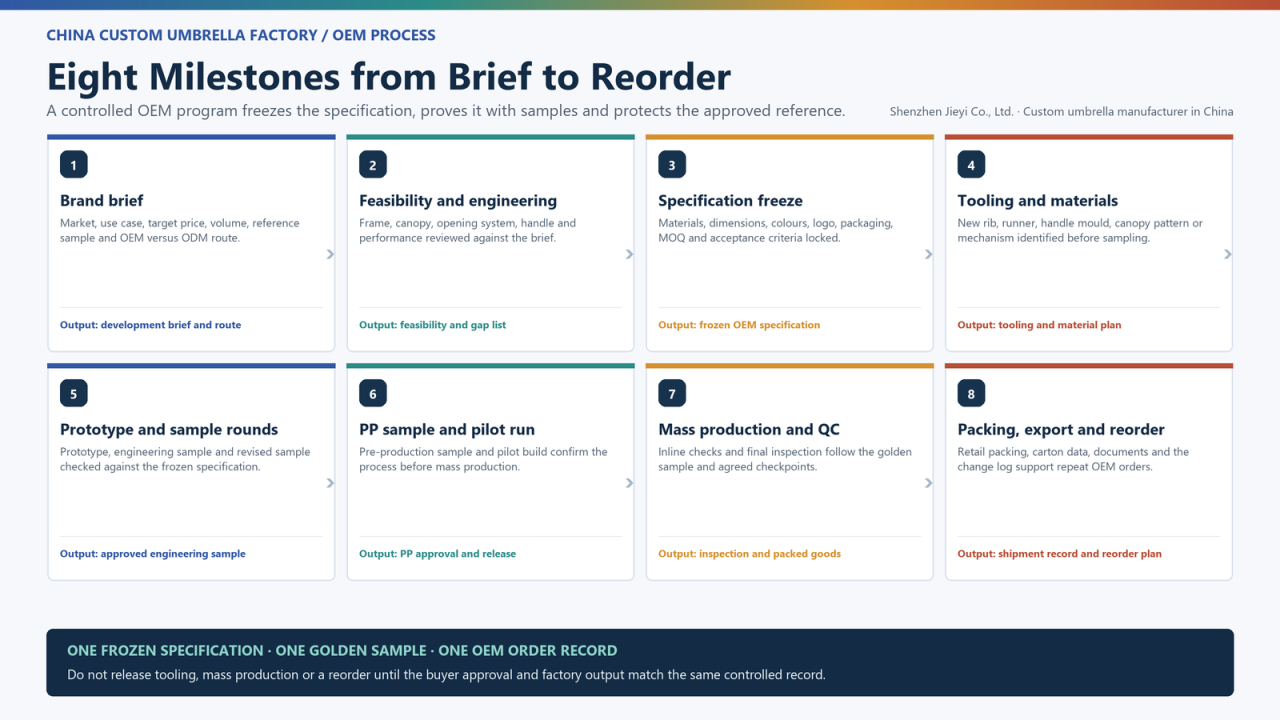
Quick answer: an OEM process at a China custom umbrella factory turns a brand brief into a controlled production specification. The usual milestones are brand brief, feasibility and engineering, specification freeze, tooling and materials, prototype and sample rounds, pre-production sample and pilot run, mass production and QC, then packing, export and reorder. The process works when each milestone has one buyer approval and one factory output stored with the order record.
What OEM means in an umbrella factory
OEM means the factory builds to the buyer’s specification. The buyer may provide drawings, a reference sample, a technical brief, material requirements, artwork, packaging direction and a collection to match. The factory turns those inputs into a product that can be sampled, produced and repeated.
ODM starts from an existing factory platform. OEM gives the buyer more design control but also more engineering, tooling and approval work. The OEM versus ODM guide explains the difference, while umbrella customization levels show where a project sits between stock, modified and full OEM.
What the buyer must provide
An OEM brief should include the market, use case, target price, expected volume and delivery window. It should also define the frame, canopy size, fabric, opening system, rib count, handle, logo, packaging, artwork ownership, test or compliance requirements and the intended reorder plan.
If some details are open, say so. A factory cannot freeze an OEM specification around missing inputs, and the umbrella RFQ checklist helps organise the first brief.
Milestone 1: Brand brief and OEM versus ODM decision
The first decision is how much design control the buyer needs. Choose OEM when the product must follow a detailed specification, a reference sample or an established collection. Choose ODM when the factory platform already provides most of the structure and the buyer mainly needs market-specific colours, branding and packaging.
Record this decision before engineering starts; it affects sampling, tooling, MOQ, cost and design ownership.
Milestone 2: Feasibility and engineering review
The factory reviews the brief against frame geometry, canopy pattern, opening system, ribs, shaft, handle interface and performance expectations. It should return a feasibility note that separates standard options, changes that require new engineering and items that need more information.
This is the stage to challenge assumptions. Canopy size, folded length or wind requirements can change the frame, mechanism or material plan. The factory platform guide explains how reuse limits affect OEM decisions.
Milestone 3: Specification freeze and commercial confirmation
Freeze the specification before tooling. The frozen record should include dimensions, materials, colours, Pantone references, logo, handle, opening system, packaging, MOQ, sample plan, lead time and acceptance criteria. The quotation should match the same scope, including Incoterms and tooling.
Milestone 4: Tooling and material development
New ribs, runners, handle moulds, canopy patterns, mechanisms or packaging inserts may require tooling. Confirm what is new, what is reused, who owns the tool and how tooling cost is treated.
Material development runs in parallel, and any substitution should be approved as a controlled change.
Milestone 5: Prototype and sample rounds
The first prototype proves the concept and basic function. The engineering sample validates materials, mechanism, fit and dimensions against the frozen specification. If changes are needed, the factory issues a revised sample with a written change list.
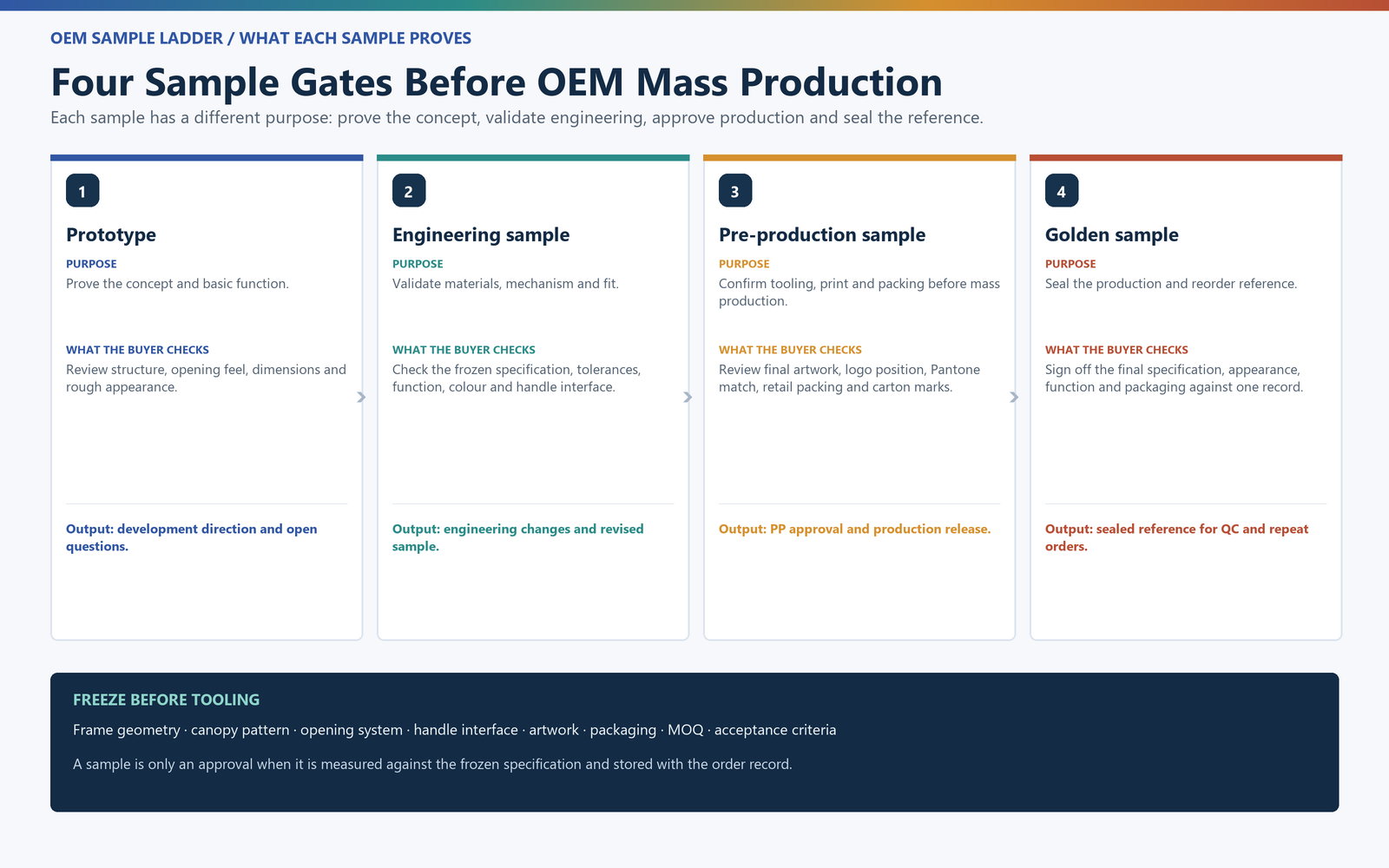
Do not treat general comments as approval. Reference the sample number, photo or measured point. The product development process shows how testing and sampling connect.
Milestone 6: Pre-production sample and pilot run
The pre-production sample confirms tooling, artwork, print position, Pantone match, handle interface, retail packing and carton marks. A pilot run can reveal assembly or packing problems that a single sample does not show.
Mass production should not start until the PP sample and pilot result are approved in writing, together with the golden sample and inspection criteria.
Milestone 7: Mass production and QC
Production follows the golden sample, the frozen specification and agreed checkpoints. Materials, printing, frame assembly, opening function, appearance and packing are inspected against the approved reference, and deviations are recorded with the approver.
The inside an umbrella factory guide explains the physical production sequence. The umbrella import, QC, carton and shipping checklist covers the buyer-side checks.
Milestone 8: Packing, export and reorder
Confirm retail packing, labels, barcodes, carton marks, packing list and shipping documents. Keep the golden sample, specification, artwork, inspection record and change log together so a reorder reuses the same approved OEM configuration. The commercial stages that sit in front of these eight development milestones are set out in the B2B order process behind your OEM program.
What to freeze before tooling
Freeze frame geometry, canopy pattern, opening system, handle interface, artwork, packaging, MOQ and acceptance criteria before tooling. A later change is a new engineering decision, not an assumed update.
Change control, tooling and intellectual property
Define who owns drawings, artwork, tooling and packaging files; how changes are approved; whether the product is exclusive; and what happens if the buyer changes supplier. Keep approvals in writing.
How Shenzhen Jieyi supports OEM programs
Shenzhen Jieyi Co., Ltd. is a Shenzhen-based manufacturer of umbrellas, beach umbrellas, garden umbrellas and outdoor shade products. It supports brands, importers, wholesalers, retailers, hotels and promotional buyers with OEM or ODM development, sampling, production, QC and export coordination.
Learn more on the factory workflow page, the OEM Custom service page, or the umbrella manufacturer selection guide.
Frequently asked questions
What is the first step in an umbrella OEM project?
Start with a written brand brief, a reference sample or drawing, the target market, quantity, price position and delivery window. The factory then reviews feasibility.
When should the OEM specification be frozen?
Freeze the specification before tooling and bulk materials are committed. Later changes should follow change control and may affect cost, MOQ or lead time.
How many sample rounds does an OEM umbrella need?
The number depends on how much is new. A platform-based OEM project may need one or two rounds; a new frame, mechanism or handle can require more.
Can an OEM umbrella be reordered without a new sample?
Yes when the golden sample, materials and tooling remain unchanged. Any change to fit, function, material or appearance may require a new sample.
From approved OEM project to market launch: agents can use the private-label umbrella launch guide to plan the first range, sample kit and launch sequence. Partners that will sell through their own channel can compare the umbrella distributor and agency program before agreeing territory or reporting terms.
Start an OEM umbrella project
Send the market, reference product, required changes, target quantity and delivery window through our contact page. We will review the practical OEM route for your custom umbrella program.