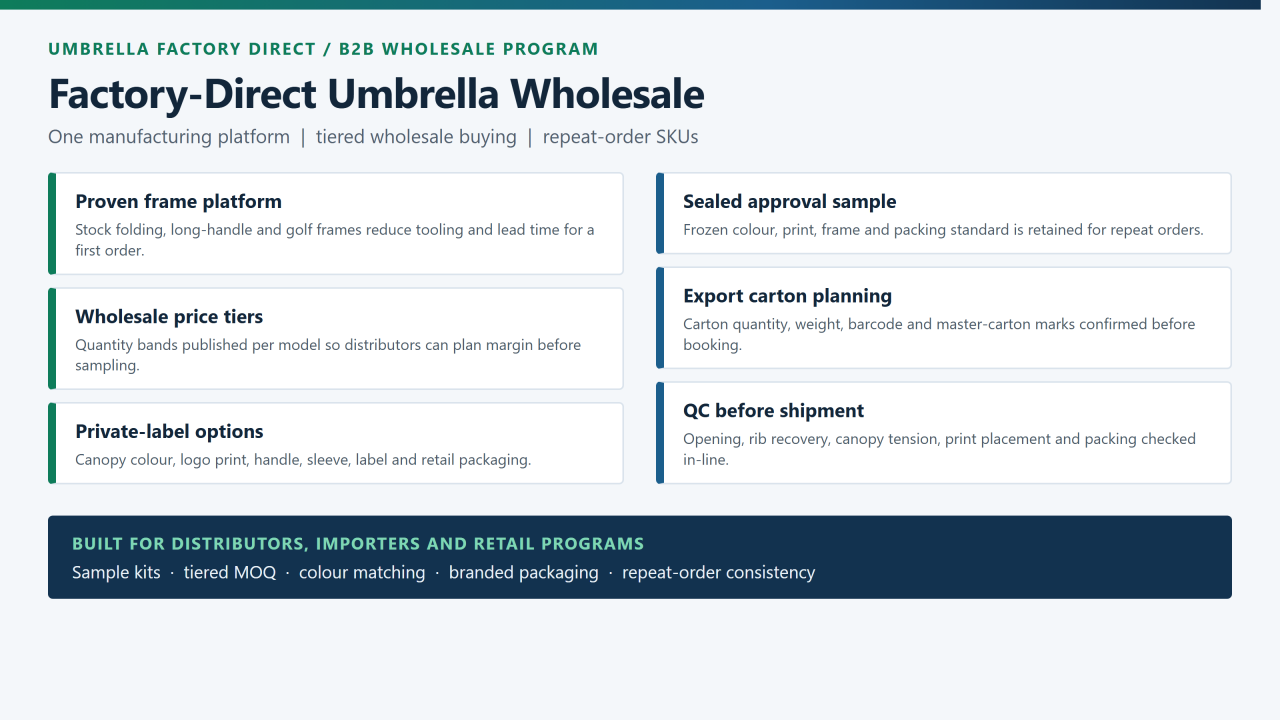
Quick answer: a factory-direct umbrella wholesale program gives distributors fixed product platforms, published quantity tiers, and a repeatable customization path instead of one-off quotations. The model works when the buyer and the factory agree on the SKU ladder, the approval sample, the carton data, and the quality standard before the first bulk order.
This guide explains how the program is structured, how it differs from buying through a trading company, and how distributors can protect margin across repeat orders.
What a factory-direct wholesale program includes
A wholesale program is more than a price list. A workable factory-direct program defines a set of proven frames, the specification for each model, quantity bands for pricing, the customization options at each band, and the documents that travel with every order. The same logic applies to finish-level differences: a buyer can keep one frame and offer either a plain black UV canopy or the antique bronze wood handle 10-rib version as a premium tier.
Because the frame platform already exists, the buyer avoids new tooling on the first order. Because the specification is written and the approved sample is retained at the factory, a repeat order follows the same standard without restarting development.
For distributors building a sellable range, start with our guide to building a B2B umbrella distribution range and confirm the product ladder before discussing price.
Factory direct versus trading company
A trading company can help with small mixed orders, but it adds a margin and separates the buyer from the production floor. Factory-direct sourcing gives the distributor direct access to the specification, sample, and production feedback loop.
- Specification control: the buyer can fix frame, canopy, handle, print, and packing details with the team that makes the product.
- Sample reference: the approved sample stays with production, so repeat orders are measured against the same standard.
- Cost transparency: quantity bands show how unit cost changes with volume instead of hiding the tier behind a single quote.
- Change control: material or artwork changes are recorded before they reach the line.
Direct sourcing still requires discipline: the buyer must be specific about the brief, quantity, and channel, because the factory engineers only to a defined requirement. Our umbrella RFQ checklist lists what shortens the quotation cycle.
Choosing the right product platforms for wholesale
Most successful wholesale ranges are built on a few platforms rather than many individual models. Three positions usually cover the market: an entry model for price-led buyers, a core model for mainstream retail and corporate accounts, and a premium model for gift and branded programs.
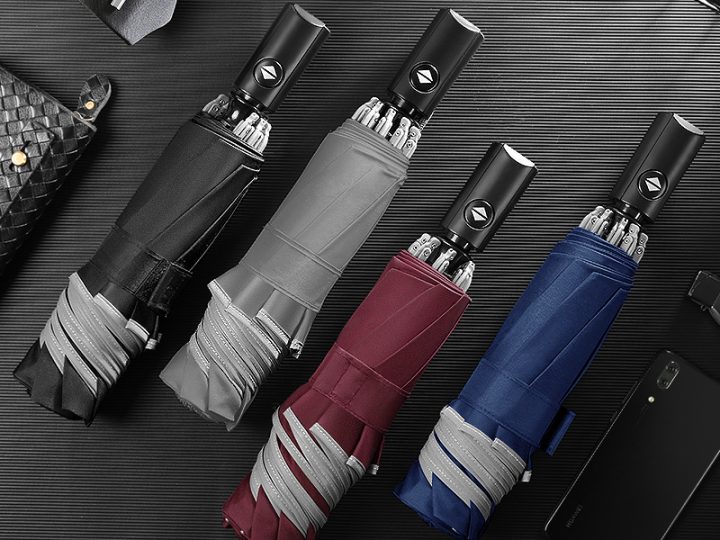
Folding umbrellas are the usual volume choice because they are compact, easy to ship, and familiar to end users. Long-handle, golf, beach, and garden formats serve premium, outdoor, and hospitality channels.
Review the rain umbrella range for core rain formats and the full umbrella product collection when comparing frames, canopy sizes, and handle options.
Pricing tiers and margin planning
Factory-direct pricing is quoted in quantity bands. Each band reflects material, printing setup, packaging, and handling per unit. A higher band lowers unit cost but ties up more working capital in stock.
Distributors should compare landed cost, not the factory unit price alone. Freight, duty, carton volume, and payment terms all change the real cost of a program. A lower unit price with inefficient cartons can cost more once shipping is included.
Plan margin against the channel that will sell the product. A promotional account tolerates a different price position from a premium retail account, so packaging and customization should match the end price.
MOQ, sampling, and first-order structure
A practical first order proves the specification without over-committing capital. Many distributors begin with one or two platforms, approve a sealed sample, and test the market before adding colourways.
MOQ depends on the frame, canopy, fabric, printing, and packaging. A stock frame with a printed canopy usually carries a lower minimum than a new frame or fully custom construction. Confirm the finished-product MOQ and the per-colour minimum separately, because they can differ. Once those minimums are agreed, the remaining steps follow a standard factory-direct B2B order process from sample approval to export packing.
Our MOQ and sampling guide explains how to plan the first order, and the canopy size guide helps match the frame to the intended channel.

Customization without losing repeatability
Distributors usually need some branding on every order. The safest approach is to standardize the platform and vary only the elements the market requires, such as canopy colour, logo print, sleeve, label, or retail packaging.
Keep the approved colour standard, artwork file, carton mark, and inspection criteria on file with the order reference. When the specification is reused, the second order needs no new colour or packaging agreement.
Compare the available umbrella customization levels before committing to a fully custom frame, and review the custom umbrella packaging guide when the channel needs retail-ready presentation.
Quality control and commercial terms
Write acceptance criteria into the purchase order. Opening and closing, runner movement, rib recovery, canopy tension, stitching, print placement, colour, labelling, and carton condition should be measurable against the approved sample.
Agree the payment schedule, lead time, inspection point, and shipping term before production. A clear Incoterm and inspection plan removes most disputes over where responsibility transfers.
Use the umbrella quality control checklist to build the inspection plan, and the umbrella import checklist to prepare the shipping documents.
Frequently asked questions
What is a factory-direct umbrella wholesale program?
It is an arrangement where a distributor buys directly from the manufacturer under agreed platforms, quantity-based price tiers, customization options, and a retained approval sample, so repeat orders follow one specification.
How many models should a first wholesale range include?
Three focused positions usually work best: an entry model, a core volume model, and a premium model. Adding more platforms before the first ones prove themselves increases MOQ, stock, and specification risk.
Is factory-direct always cheaper than a trading company?
Not automatically. Factory-direct pricing often improves at volume, but total landed cost still depends on carton efficiency, freight, duty, and payment terms. Compare total cost and specification control, not unit price alone.
What should be confirmed before the first bulk order?
Confirm the sealed sample, written specification, MOQ, quantity tier, packaging and carton data, inspection criteria, payment schedule, lead time, and shipping term.
Request a factory-direct wholesale quotation
Send the intended channel, quantity, colour mix, logo artwork, packaging direction, and destination through our contact page to receive a factory-direct wholesale quotation.
Factory-direct or trading company: what changes for the buyer
| Decision | Factory-direct program | Trading-company route |
|---|---|---|
| Specification control | Direct discussion with tooling, sampling and production teams. | Information may pass through an intermediary. |
| Component changes | Can be evaluated against an existing platform and production line. | Depends on the supplier network and confirmation process. |
| Cost visibility | Material, tooling, packing and production assumptions can be separated. | May be bundled into a single trading price. |
| Quality evidence | Inspection format and sample approval can be agreed directly. | The buyer should confirm who owns the QC record. |
| Best fit | Buyers planning repeat production and controlled customization. | Small, fragmented or highly mixed sourcing requirements. |
Factory-direct is not automatically cheaper. It is valuable when the buyer needs specification control, repeatability and a clear production route. Compare the factory workflow and the OEM development process.
90-day wholesale program timeline
| Stage | Typical window | Exit evidence |
|---|---|---|
| Brief and platform selection | Day 0-5 | Product brief, target quantity, platform and commercial target. |
| Quotation and mockup | Day 3-10 | Comparable specification, artwork mockup and cost breakdown. |
| Sample production | Day 7-20 | Physical sample, dimensions and colour reference. |
| Sample approval | Day 20-28 | Signed approval sheet and revision-controlled specification. |
| Bulk production | Day 28-55 | Material confirmation, production update and inspection plan. |
| QC and export packing | Day 55-70 | Inspection release, carton marks and shipping documents. |
| Shipment and reorder plan | Day 70-90 | Shipment file, sealed sample and next-order forecast. |
MOQ and pricing tiers without misleading comparisons
| Cost or quantity factor | What changes | Buyer action |
|---|---|---|
| Platform reuse | Existing frame and mechanism can support a lower trial quantity. | Start from a proven format before requesting new tooling. |
| New tooling | New handle mould, rib or mechanism raises setup cost. | Confirm tooling charge, ownership and amortisation. |
| Logo and colour count | Print positions, Pantone matching and set-up change unit cost. | Approve artwork on the actual fabric. |
| Packaging | Retail box, insert and barcode increase minimum run and packing labour. | Price a trade pack and a premium pack separately. |
| Freight | Carton quantity and packed dimensions change landed cost. | Compare delivered cost, not only ex-factory price. |
Use the RFQ checklist so each supplier quotes the same specification. Review the product directory for current platform examples.
Quality and export evidence pack
- Approved sample for every colour, logo and packaging version.
- Frame, rib, shaft, runner and handle inspection records.
- Opening and closing cycle results and canopy tension checks.
- Print position, colour and surface finish approval.
- Carton quantity, gross weight, dimensions and shipping marks.
- Pre-shipment inspection release and sealed production sample.
For platform examples, review the 10-rib golden-frame business umbrella and the 12-rib automatic business umbrella. Mechanism decisions are explained in the opening systems guide.