Quick answer: a China custom umbrella factory partnership should start with a base platform and a defined customisation level, not a logo added to an unknown stock product. The distributor, wholesaler or agent then owns the commercial route while the factory coordinates development, sampling, production, quality control and export support.
Custom factory versus stock wholesale
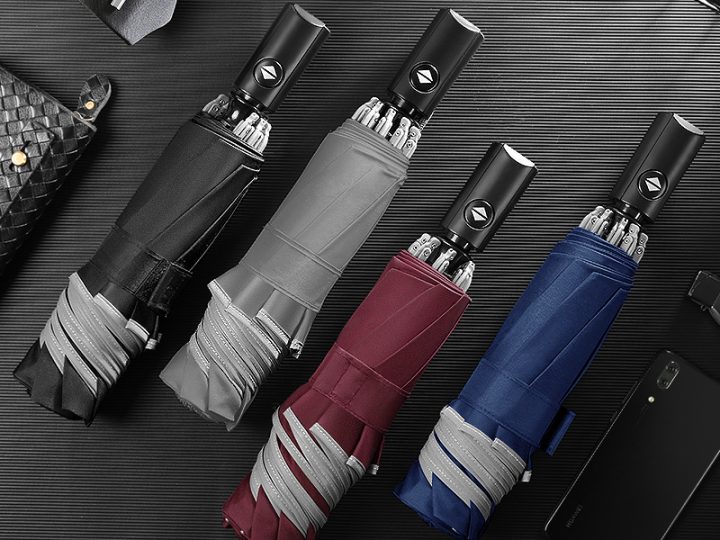
A stock umbrella program is built around an existing model, colour and packing. A custom program adds choices that affect the product, the MOQ and the production plan: fabric, size, frame, ribs, handle, colour, logo, packaging and branding.
The more a buyer changes, the more important it is to define the starting platform. A proven model can often be modified with new colours and branding, while a new construction may require development and tooling. Our umbrella customization levels explain stock, modified and OEM routes.
Three routes for a custom umbrella program
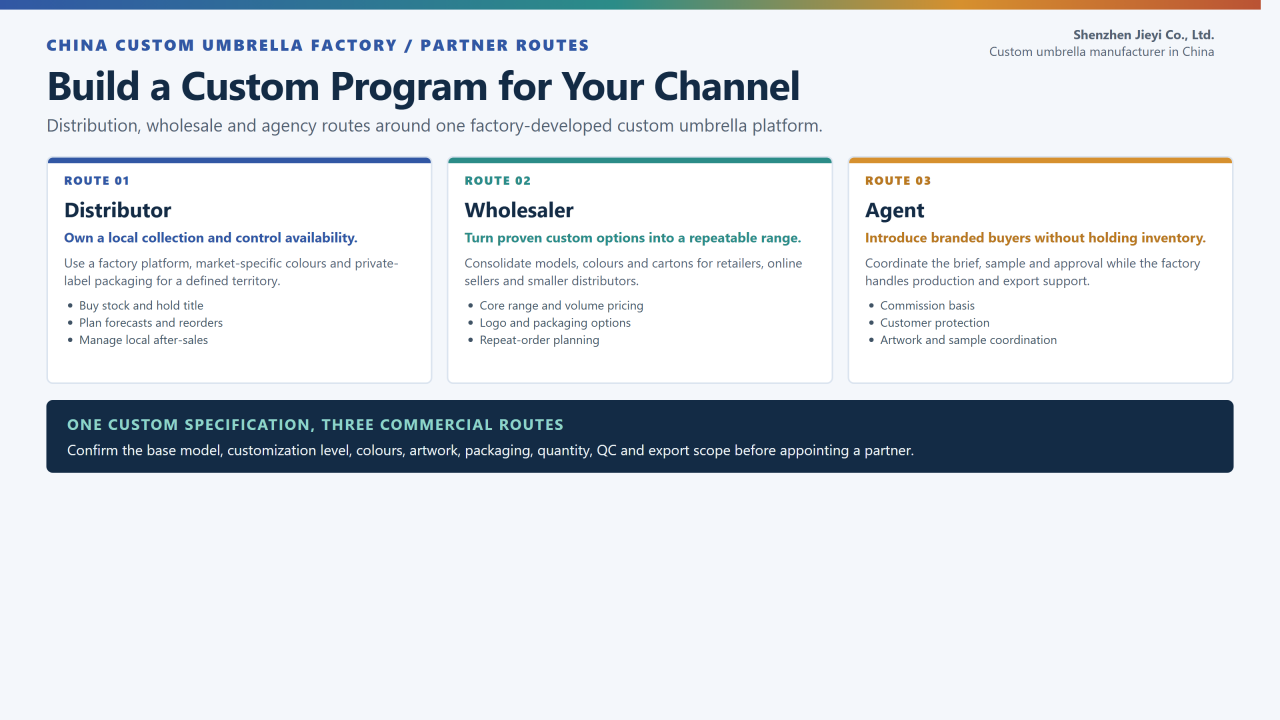
Distributor. A distributor buys custom stock, takes title and builds a local collection for a defined territory. This works when the partner can forecast demand, hold inventory and manage after-sales. The custom specification should be stable enough for repeat production.
Wholesaler. A wholesaler consolidates models, colours and cartons for retailers, online sellers or smaller distributors. The strongest wholesale range usually mixes a proven base platform with a controlled set of logo and packaging options instead of offering unlimited changes.
Agent. An agent introduces brand, retail or promotional buyers and earns commission without holding inventory. For custom projects, the agent often coordinates the brief, artwork, sample feedback and approval. The agreement should define the protected customer, commission basis and who communicates with the factory.
Choose the base platform before the artwork
Start with the product format: straight or folding, automatic or manual, compact or full size, rain or sun use, and the required canopy size. Then confirm the frame, ribs, handle, fabric and opening system.
A base platform gives the buyer a known starting point. The factory can review the requested changes, explain which options are standard and which require sampling or new tooling, and quote the correct MOQ. The custom umbrella platform development guide covers this process.
Custom details that affect the distribution plan
Colour and artwork. Approve Pantone references, logo position, print method and artwork ownership. Keep the approved file with the order reference.
Packaging. Confirm fabric sleeve, OPP bag, gift box, retail label, barcode and carton marks. Packaging can change the carton count and the landed-cost calculation.
Quantity. Separate the sample quantity, opening order and planned reorder quantity. A custom SKU may have a different MOQ from a stock model.
QC and export documents. Agree on the approval sample, inspection points, packing list and destination document requirements before production.

A six-stage custom factory workflow
1. Channel brief. Define the market, customer type, sales channel, target price and expected volume.
2. Platform selection. Choose a proven model or start an OEM/ODM development route. The OEM versus ODM guide explains the difference. The stages that follow, including quotation, sample approval and pre-production release, are described in how B2B orders are processed.
3. Quotation. Compare the same platform, customisation level, packaging, quantity and delivery scope. The umbrella RFQ checklist lists what to send.
4. Sample approval. Check function, materials, colour, logo, handle and packing before bulk production.
5. Production and inspection. Confirm artwork, carton marks, payment schedule and inspection criteria in writing.
6. Launch and reorder. Review sell-through, complaints and stock, then extend colours or models from the same approved platform.
How to evaluate a China custom umbrella factory
Confirm the legal entity and factory address. Review the product and customisation scope, including whether the factory supports logo printing, Pantone matching, private-label packaging, OEM or ODM development and export coordination.
Ask for a sample plan and a written quotation that separates product, packaging, tooling and shipping scope. The factory workflow page and OEM Custom service page show the areas to discuss.
Terms to define with distributors, wholesalers and agents
Write down the territory, customer or channel scope, price basis, opening order, reorder quantity, sample ownership, artwork rights, tooling ownership, warranty process and review date. Keep exclusivity conditional on a target or scheduled review.
For custom products, also confirm who approves artwork, who owns the Pantone and packaging files, and what happens if a colour or construction must change after the sample is approved. The umbrella wholesale agency and distributor program guide covers the commercial roles.
What Shenzhen Jieyi provides
Shenzhen Jieyi Co., Ltd. is a Shenzhen-based manufacturer of umbrellas, beach umbrellas, garden umbrellas and outdoor shade products. The company supports global brands, importers, wholesalers, retailers, hotels and promotional buyers with product development, sampling, production, quality control and export coordination.
Customisation support includes fabrics, frames, ribs, handles, Pantone colour matching, logo printing, private-label packaging and OEM or ODM development. Learn more on the about us page.
Common custom partnership mistakes
Common mistakes include quoting before the brief is complete, comparing suppliers on different specifications, changing the construction after sample approval and appointing an exclusive partner without a performance review. Keep one approved sample, one written specification and one responsible contact on each side.
Frequently asked questions
Can a distributor create a custom umbrella collection?
Yes. A distributor can start from a factory platform, approve a custom colour or branding program, hold stock and sell it in a defined market.
Can a wholesaler offer custom umbrellas to retailers?
Yes. A controlled range of platform models, colours and packaging options can be offered to retailers without creating a new product for every buyer.
Can an agent work on a custom factory project?
Yes. An agent can introduce the buyer and coordinate the brief, sample and approval while the factory handles production and export support.
What should be confirmed before the first custom order?
Confirm the base platform, customisation level, artwork, colours, packaging, quantity, QC criteria, lead time and delivery terms.
Discuss a custom umbrella partnership
Send your market, channel, base model, target quantity and branding requirements through our contact page. We will review the most practical distribution, wholesale or agency route for your custom project.