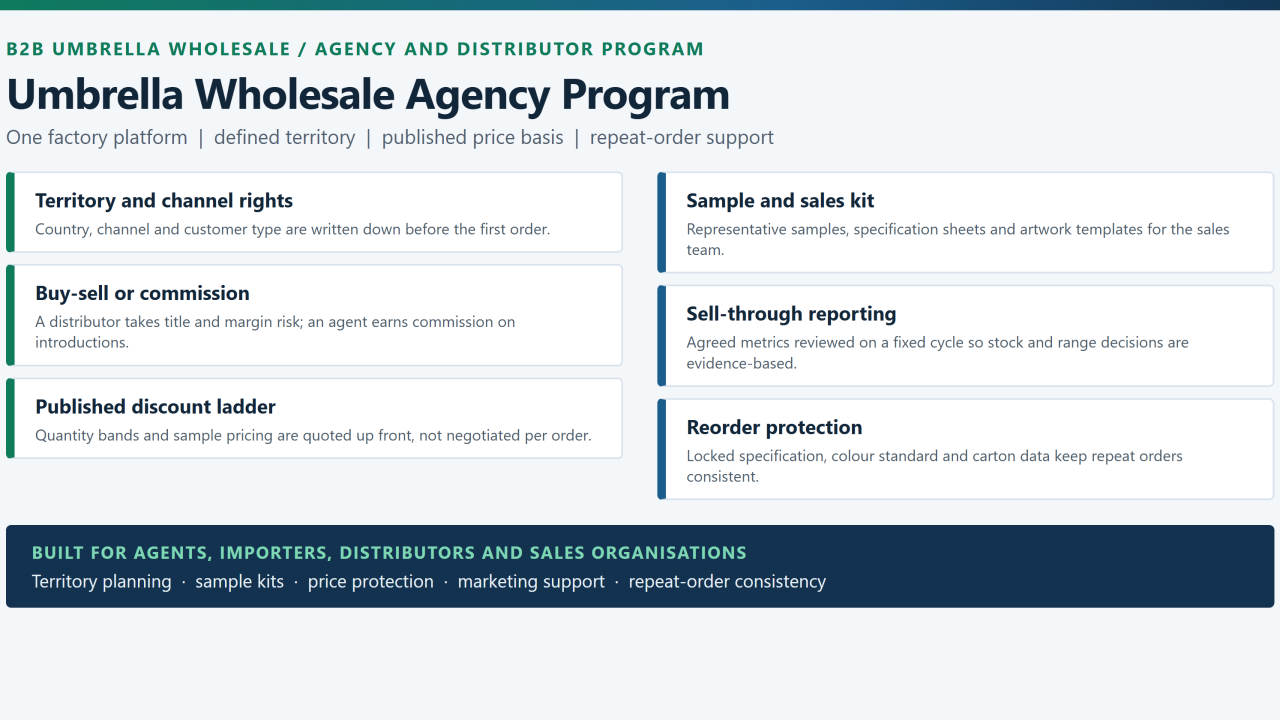
Quick answer: a workable umbrella wholesale agency program defines four things before the first order: the territory and channel the partner owns, the price basis (buy-sell discount or commission), the support the factory supplies, and how sell-through is reported. Get those four right and repeat orders run on one locked specification instead of a fresh negotiation.
It is written for agents, distributors, sales organisations and manufacturers appointing partners in new markets.
Agency or distributor: pick the model first
The two words are often used interchangeably, but they carry different risk. A distributor buys the goods, takes title, holds stock and earns a margin on resale. An agent introduces buyers and earns commission, usually without carrying inventory.
A distributor suits a market where the partner has warehousing, credit terms and retail relationships. An agent suits an early-stage market or a partner whose strength is contacts rather than logistics. Many companies start with an agent to test demand and convert once volumes justify stock.
Write the model down before pricing is discussed, because it decides who pays freight, who carries dead stock and who owns the customer relationship.
Agent, distributor and private-label distributor compared
| Partner model | Who owns the sale | How the partner earns | Best fit |
|---|---|---|---|
| Agent | Introduces buyers and coordinates the opportunity. | Commission or agreed referral fee without normally holding stock. | Early market test, relationship-led sales or a partner without warehousing. |
| Distributor | Buys and resells stock under agreed channel or territory terms. | Margin on resale, with responsibility for local stock and customer service. | Markets where local inventory, credit and delivery are important. |
| Private-label distributor | Sells a product carrying its own brand through agreed channels. | Resale margin plus control over brand, packaging and positioning. | Retail, corporate-gift or online ranges that need brand differentiation. |
The product and packaging process behind the third model is covered in the private-label umbrella launch guide. Use it to define the sample standard before territory sales begin.
Define territory and channel rights before the first order
Territory is not just a country. Two partners in the same country can serve different channels without conflict: one might supply supermarkets and retail chains, another corporate gifts and promotional agencies, a third online sellers.
Write the boundary as country plus channel plus customer type. If exclusivity is requested, attach a condition to it: an annual volume target, a minimum first order, or a review date. Exclusivity without a performance condition removes your ability to appoint a second partner if the first one stalls.
Our guide to China umbrella factory distribution and agency guide covers how to stage markets and channel roles.
Decide the price basis
Distributors normally work from a discount ladder: a factory list price with quantity bands that improve at volume. Agents normally work from a commission percentage applied to net invoiced value. Mixing the two in one contract without defining which applies creates disputes on the first repeat order.
Publish the ladder so partners can plan margin before sampling. A partner who cannot calculate a selling price from the quotation will ask for a special price on every order, and each request costs the factory time.
Where a market needs a different price position, keep the platform and change the packaging or the branding rather than discounting the same specification. The umbrella customization levels explain which changes are stock options and which require new tooling.
What the factory should supply
A partner cannot sell what they cannot demonstrate. The program should include a small sample kit, specification sheets with frame, canopy, handle, size and weight data, artwork templates for logo placement, and carton and label information.
Sample kits do not need to be large; two or three models covering entry, core and premium positions are enough to open conversations. Our umbrella RFQ and sampling checklist explains how sample quantities relate to the production minimum.
Sell-through reporting and the review cycle
Ask for simple reporting from the start: units sold by model and colour, remaining stock, returns or complaints, and which channels produced them. A quarterly review is enough to decide whether to extend the range or reset the target.
Reporting protects both sides: slow-moving stock can be helped with a different colour or smaller pack, and fast sell-through can be rewarded with priority scheduling and a wider territory.
The distributor selection checklist is a useful template for scoring partners at appointment and review.
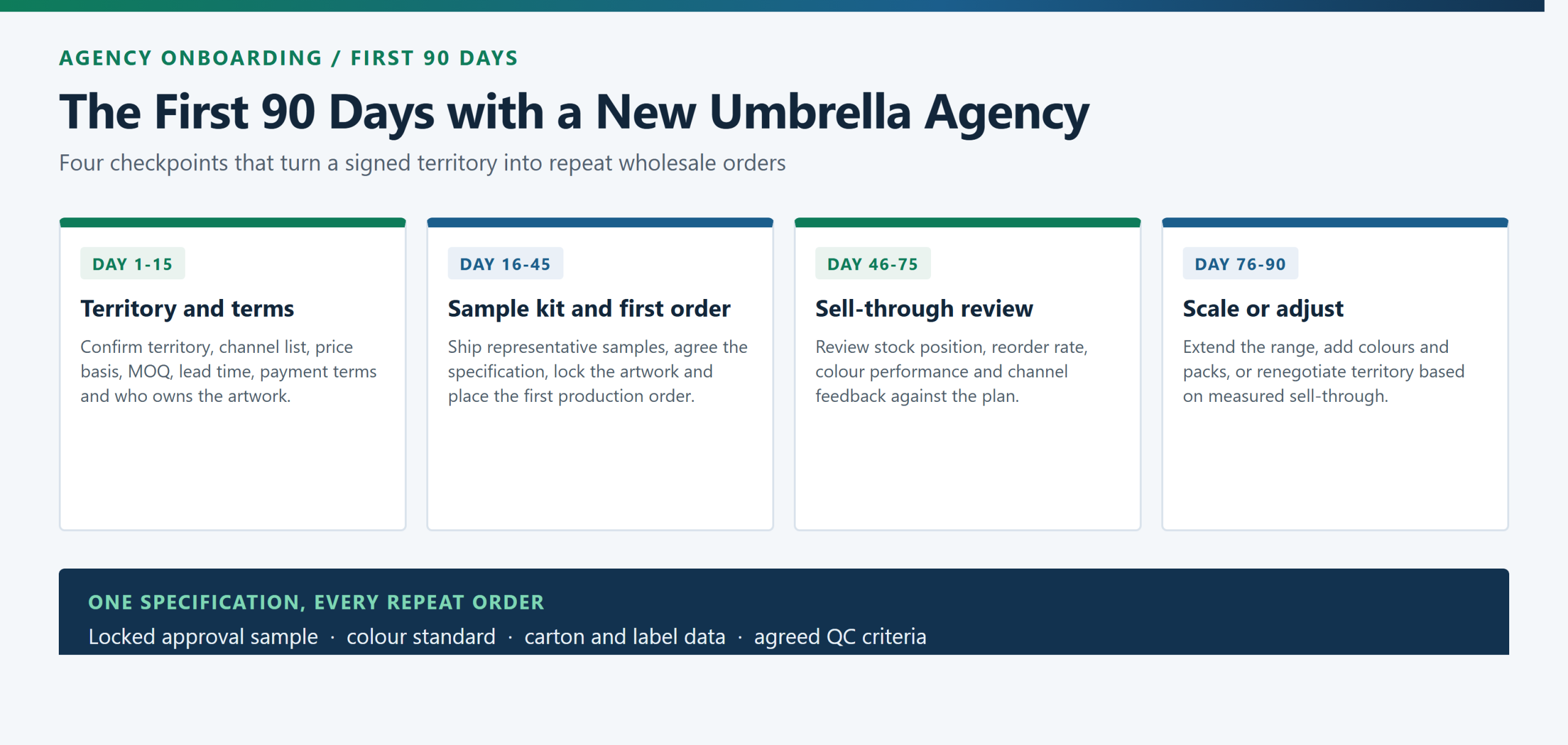
The first 90 days with a new agency
Days one to fifteen are for paperwork and alignment: signed territory, channel list, price basis, MOQ, lead time, payment terms and artwork ownership. Days sixteen to forty-five cover the sample kit, the agreed specification, artwork lock and the first production order.
Days forty-six to seventy-five are the first honest read on the market through stock position and reorder rate. Days seventy-six to ninety are for the decision: extend the range, add colours and packs, or renegotiate the territory.
How agency programs break
Three failures account for most problems. The first is an undefined channel, which ends with two partners quoting the same buyer. The second is a price basis that is renegotiated on every order, which erodes both margin and trust. The third is a specification that quietly changes between orders, which turns a repeat order into a new project.
Prevent the third by keeping a sealed approval sample at the factory and recording the colour standard, carton marks, labels and packing with the order reference. The umbrella import, QC and carton checklist can be used as the inspection reference for the partner and the factory.
Shorten the quotation cycle by sending a complete brief: destination, channel, quantity, colours, artwork, packaging and target price. The umbrella RFQ checklist lists what the factory needs.
Frequently asked questions
What is the difference between an umbrella agent and an umbrella distributor?
A distributor buys stock, takes title and earns a resale margin. An agent introduces buyers and earns commission without holding inventory.
Should a first appointment include exclusivity?
Only with a condition. Tie exclusivity to an annual volume target, a minimum first order or a review date, so the territory can be reopened if the partner does not perform.
How many models should a sample kit include?
Two or three representative models covering entry, core and premium positions are usually enough to open conversations without carrying the cost of a full catalogue.
What should a partner report every quarter?
Units sold by model and colour, remaining stock, returns or complaints, and the channels that produced the sales.
Apply for a wholesale agency program
Send your market, channel, current customer types and expected annual volume through our contact page. We will suggest the most practical program structure and share the wholesale terms for your territory.
For a deeper look at territory planning and factory-side support, read the China umbrella factory distribution and agency guide.
Design the agency or distributor program
Start with the commercial structure before adding products: territory, customer ownership, price basis, sample kit, marketing support, reporting, warranty and repeat-order terms. A clear program reduces conflict between the agent, distributor and factory while giving the end customer one consistent product and service standard.
Use these resources to build the program from product platform to private-label launch: