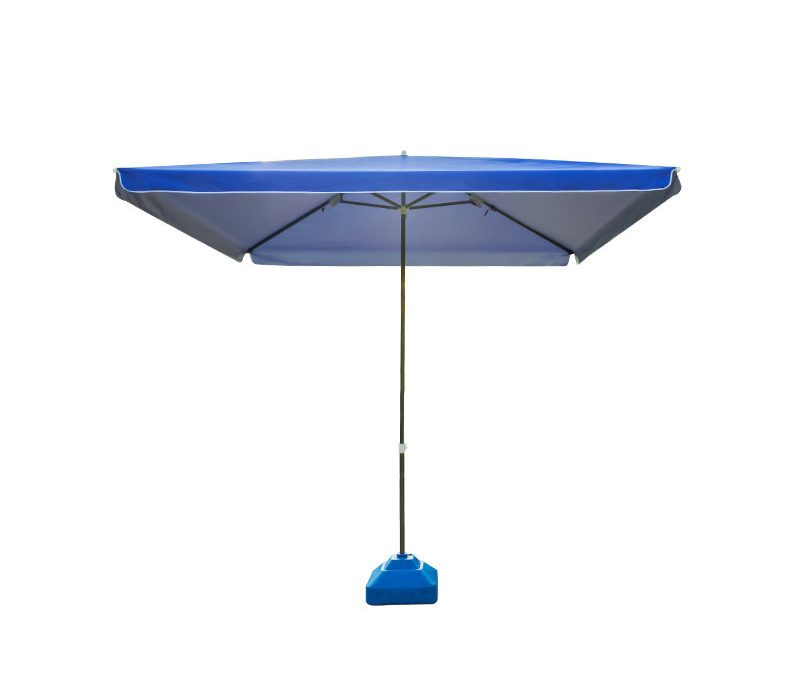
This commercial patio umbrella case study began with a restaurant group planning outdoor dining across several locations. The buyer needed shade that would look consistent, stand up to daily service, remain stable in changing weather, and carry the group identity without dominating the guest environment.
Our team reviewed the outdoor layouts, table spacing, wind exposure, storage arrangements, branding, and replacement plan before setting the final product specification.
Why outdoor dining needs a commercial patio umbrella program
A restaurant terrace uses umbrellas differently from a residential garden. Staff open and close them throughout the day, move them for service, clean around bases, and store them after closing. The product must therefore balance appearance with practical operation, maintenance, and replacement.
Buying from a generic catalogue without reviewing the site can lead to problems later: a canopy that is too large for the terrace, a base that blocks movement, a fabric that fades quickly, or a frame that becomes difficult to operate after repeated use. A commercial program starts by defining how the umbrellas will be used and maintained.
Choosing canopy size for restaurant layouts
Canopy size should be selected against the actual table plan rather than by diameter alone. The umbrella needs to cover the intended seating area without creating a collision risk or reducing circulation between tables. Square and rectangular canopies can suit organised dining layouts, while octagonal canopies often work better where tables are arranged in clusters.
We reviewed overhead clearance, canopy overlap, walking routes, and the position of the pole and base. This step is especially important for a multi-site rollout because the same umbrella may be used on terraces with different dimensions and service layouts. The selected platform can be reviewed through the commercial garden patio umbrella and the larger large outdoor square umbrella with water base option.
Wind stability, frame, and base planning
Outdoor dining umbrellas need to remain controllable in normal wind conditions. The pole, ribs, hub, crank, tilt joint, canopy tension, and base all affect stability, so they should be specified as one system. A strong frame paired with an unsuitable base can still fail, while a heavy base alone cannot correct a loose canopy or weak connections.
For this project we reviewed the relationship between canopy size, pole diameter, frame construction, operating mechanism, and base footprint. The buyer also defined when staff should close the umbrellas during high wind rather than relying on the product to remain open in every condition. These checks follow the same logic as our umbrella wind resistance guide.
Canopy fabric, colour, and UPF protection
Restaurant umbrellas are exposed to strong daylight and repeated cleaning, so fabric selection affects both appearance and service life. We reviewed fabric weight, weave, coating, colourfastness, water behaviour, and the finished canopy rather than treating the fabric specification as a price-only decision.
Where sun protection is part of the guest promise, a UPF 50+ canopy option can support the specification. The claim should be tied to the finished canopy, including its coating and construction, and confirmed on the production sample. Colour was also checked under natural light because a shade that looks correct on screen can appear different across a large terrace. More detail is available in our umbrella fabric selection guide.
Branding that works at guest level
Restaurant branding should support recognition without turning every umbrella into a large advertisement. The valance offers a clean area for a logo, property name, or seasonal message. Canopy panels can carry a stronger brand treatment, but the design must account for seams, tension, and the viewing angle from tables and entrances.
We coordinated logo scale, colour, placement, and print method with the terrace layout. For groups with several brands, the same structural platform can be used with different valance artwork and colour systems, reducing production complexity while preserving each location’s identity.
Packaging, storage, and multi-site delivery
A multi-location order needs more than correctly packed cartons. Each site should receive the right quantity, colour, and replacement parts, and the packaging should make receiving and seasonal storage straightforward. Where spare canopies or bases may be needed, they should be planned as separate line items rather than improvised later.
We prepared carton marks, packing quantities, and destination information as part of the initial umbrella RFQ checklist. This reduces the risk of mixed shipments and makes future reorders easier to compare.
Sample validation for a commercial patio umbrella
The sample was reviewed for opening and closing effort, crank travel, tilt control, pole alignment, rib tension, canopy symmetry, hardware finish, base compatibility, fabric appearance, and print registration. The buyer also assessed how the finished umbrella would look from guest seating and how easily staff could move and store it.
The approved sample was retained as the production reference. Before shipment, inspection covered function, appearance, branding, hardware, and packing together, following the structure of our umbrella quality control checklist.
Building a repeatable B2B patio umbrella program
A restaurant group benefits when the umbrella specification is documented as a platform rather than a one-off purchase. The platform defines the frame, canopy, base, branding, packaging, and approved colour range. Individual locations can then select from that system without creating a new product every time.
This approach also improves replacement planning. When a canopy is damaged or a location expands, the buyer can reorder against the approved specification instead of matching by photograph. For groups developing a broader outdoor collection, our OEM and ODM customization process explains how frames, fabrics, branding, and packaging can be developed together.
Related products
Start with the commercial garden patio umbrella or the large outdoor square umbrella. Buyers comparing formats can review the garden umbrella range, while cafés and smaller terraces may also consider the UPF 50+ sun umbrella.